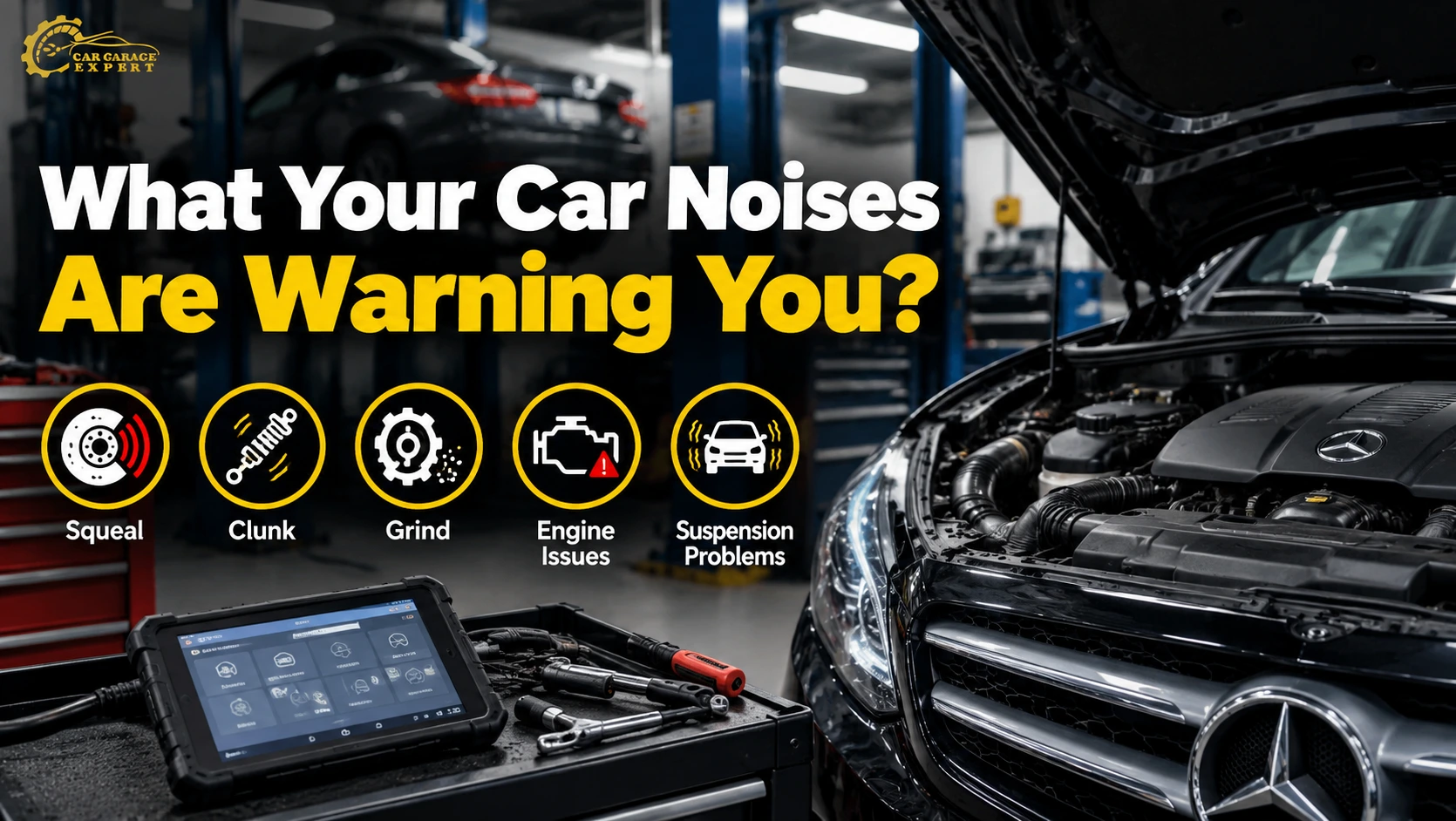
Every car makes some noise. The problem starts when a new sound appears and does not go away. Strange car noises coming from car parts usually mean something is worn, loose, or running low on fluid. The type of sound gives you the first clue. When it happens gives you the second. Braking, turning, speeding up, and cold starts all point to different parts. This guide explains what each sound means, why it happens, and when you need an inspection.
Car Noises Quick Answer: What Each Sound Usually Means
Most car noises come from one system. When brake pads or a drive belt slip, the car will squeak. If your car clunks over bumps, suspension parts like sway bar links or bushings may be worn out. Grinding when you brake means the pads are worn down to metal. A vacuum or coolant leak often causes hissing sounds under the hood. Low oil or the wrong fuel can cause an engine to knock. If it clicks when you turn, your CV joint is likely worn out. A loose heat shield is often what’s shaking under the car. Disc brakes that grind, deep engine knocks, and steam hissing need fixing right away. In a week, check most of the other noises.
Table of Contents
- What different noises mean
- Squealing noises
- Clunking noises
- Grinding noises
- Hissing noises
- Engine knocking and ticking.
- Rattling and whining noises
- Clicking noises
- Why cars start making new noises
- Dangerous noises and when to stop driving
- How mechanics find the cause
- How noise problems are repaired
- Repair costs in Dubai
- How to prevent new noises
- Dubai driving and new sounds
- Regular maintenance in Dubai
- FAQs
- Related services
- Book a noise check
What Do Different Car Noises Mean?
Each part of a car fails with its own sound. Brakes squeal and grind. Suspension clunks—belts squeal. Leaks hiss. Learning car noises and their meanings helps you describe the problem clearly and judge how urgent it is.
How to Identify a Car Noises by Sound
First, name the sound. It sounds loud and sharp when rubber or metal rubs together. Most of the time, a dull clunk means two parts are rubbing together because something is loose. It sounds like metal cutting through metal. Most of the time, a hiss means gas, steam, or air is escaping. The wheel speed is often matched by a steady click.
Next, pay attention to where it comes from. It can be in the front, back, left, or right, under the hood, or under the floor. Finding the source of a car noises takes less time if you know where it is.
Why Does the Timing of a Noise Matter?
The same sound can mean different things depending on when it happens. A squeal when braking points to the brakes—a squeal when you rev the engine points to the drive belt. So always note what you were doing: braking, turning, speeding up, going over bumps, or starting the engine.
It can be very helpful to do an easy test. Carefully park the car, put it in neutral or park, and slowly start the engine. If the noise changes with engine speed, the problem is in the engine bay. If it only happens when you’re moving, it most likely comes from the wheels, brakes, suspension, or driveline. This step takes a minute, and most guides skip it. It can cut the number of possible reasons in half.
Record the noise on your phone too. Hold it near the area, say what you are doing as you record, and keep the clip short. A 15-second video tells a mechanic far more than “it makes a weird sound”.
Car Noises Chart: Sound, Likely Cause and Urgency
Use this chart to match the noise with its most likely cause. The last column shows how soon you need to act.
| Noise and When It Happens | Most Likely Cause | How Urgent |
| Squeal when braking | Worn brake pads or wear indicator | Book within a week |
| Squeal when accelerating or starting | Slipping drive belt or worn tensioner | Book within a week |
| Clunk over bumps | Worn sway bar links, bushings or strut mounts | Book within a week |
| Grinding when braking | Pads worn to metal, damaged discs | Stop driving soon |
| Hum or grind that rises with speed | Worn wheel bearing | Book within days |
| Hiss with steam or sweet smell | Coolant leak | Stop driving now |
| Deep knock from the engine | Low oil or worn engine bearings | Stop driving now |
| Clicking when turning | Worn CV joint | Book within days |
Why Is My Car Making a Squealing Noise?
Squealing is one of the most common car noises. It almost always comes from the brakes or the drive belt. When it happens tells you which.
Squealing Noise When Braking
Many brake pads have a small metal tab called a wear indicator. When the pads get thin, the tab touches the disc and squeals. It is a built-in warning to replace the pads. Glazed pads, dust, and cheap pad material can also squeal. A brake service replaces the pads and checks the discs for wear.
Squealing Noise When Accelerating
A squeal that rises when you press the accelerator usually comes from the drive belt. The belt runs the alternator, AC compressor, and other parts. When it stretches, cracks, or the tensioner weakens, it slips on the pulleys and squeals. Fluid on the belt from an oil or coolant leak can cause the same sound.
Squealing Noise When Starting the Engine
A short shriek on a cold start might often be from a worn or loose belt. Rubber is harder when cold , so it slides until it heats up . If the screech continues after the engine is started, check belt tension. A grinding sound immediately after starting may suggest the starter motor isn’t disengaging.
What Causes a Clunking Noise When Driving?
A clunk means two parts are knocking together because something has worn or come loose. Most clunks come from the suspension, steering, or engine mounts.
Clunking Noise Over Bumps
Clunks over speed bumps usually come from worn sway bar links, control arm bushings, or strut mounts. These parts hold the suspension in place. Once the rubber wears or the joints loosen, metal parts knock together. Worn shock absorbers can also let the suspension bottom out with a thud.
Clunking Noise When Turning
Strut mounts and ball joints commonly cause a clunk when turning. A loose steering rack and worn tie rods might also make knocking noises. If you hear the clunk with loose or wandering steering, get it examined soon.
Clunking Noise When Shifting Gears
If you hear a clunk when shifting from park to drive or reverse, it’s usually a sign of bad engine or gearbox mounts. The engine rocks more than it should and bangs against the body. A worn universal joint can also cause a clunk in rear-wheel-drive autos. Low transmission fluid can also cause harsh, clumsy shifts.
Why Does My Car Make a Grinding Noise?
Grinding is metal scraping on metal. It is one of the clearest car noises that indicates a car problem, because metal parts should never rub directly.
Grinding Noise When Braking
Grinding when you brake usually means the pads are worn through. The metal backing plate is now cutting into the disc. Braking gets weaker, and the discs get damaged fast. A small stone stuck between the disc and its shield can also grind. Either way, check the brakes right away.
Grinding Noise While Driving
A grinding or humming noise that rises with speed often comes from a worn wheel bearing. It may get louder when you turn one way and quieter the other. A dry CV joint or a stuck brake caliper can also grind while you drive.
Grinding Noise When Changing Gears
In a manual car, grinding during shifts could signal a worn-out clutch or worn synchronizers in the gearbox. An automated grind may indicate low fluid or internal wear. Both need their gearboxes checked before the damage extends
What Causes a Hissing Noise From a Car?
Hissing means air, steam, or gas is escaping. Some hissing is normal for a few seconds. A hiss that keeps going is a leak.
Hissing Noise From the Engine
A hiss from the engine bay while it runs often comes from a vacuum leak. A cracked hose or loose fitting lets air in. You may also notice rough idle, a check engine light, or poor fuel economy. A brake booster leak can also hiss when you press the brake pedal.
Hissing From a Coolant Leak
If you hear a hiss with steam or a sweet scent, it means hot coolant is leaking. The leak could be in a pipe, radiator or radiator cap. Pull over and kill the engine. Do not open the radiator cap when the engine is hot. The coolant’s under pressure and might burn you.
Hissing Noise From the Air Conditioning System
A short hiss from the dashboard after you switch the car off is normal. The AC system is evening out its pressure. A constant hiss while the AC runs, with weak cooling, can mean a refrigerant leak or a failing expansion valve.
What Does an Engine Knocking or Ticking Noise Mean?
Knocking and ticking come from inside the engine. Some causes are minor. Others mean serious internal wear.
Engine Knocking When Accelerating
A light, pinging knock when you accelerate hard often means fuel is burning at the wrong moment. Using lower-octane fuel than your manual asks for is a common cause. Carbon build-up and a faulty knock sensor can also cause it. A deep, heavy knock that gets louder with engine speed is far more serious. It can mean worn rod bearings, and you should switch off the engine.
Ticking Noise at Idle
If you hear a little ticking at idle, it’s usually the valves or lifters. Dirty oil or low oil makes it worse. A leaking exhaust manifold, especially while the engine is cold, may also cause ticking. Some injectors twitch silently, which is normal on many engines.
Low Engine Oil and Engine Noise
Oil cushions all the engine’s moving parts. As the level falls, the metal parts begin to tap and knock. When the engine sounds louder than normal, check the dipstick first. Driving with low oil can ruin an engine in minutes..
Why Is My Car Making a Rattling or Whining Noise?
Rattles usually come from loose parts. Whines usually come from spinning parts, like pumps, bearings, and gears.
Rattling Noise Under the Car
A rattle under the car over bumps or at idle is often a loose heat shield. These thin metal covers protect the floor from the hot exhaust. Rust or a broken clip lets them vibrate. A broken exhaust hanger or a damaged catalytic converter can also rattle. Loose trim or a bumper clip broken in a minor scrape can rattle too.
Whining Noise When Accelerating
A whine that rises with speed can come from the transmission or the differential. Low or worn fluid is a common cause. A whine that follows engine speed may come from the alternator or another belt-driven part.
Whining Noise When Turning the Steering Wheel
A whine when you turn the wheel usually comes from the power steering pump. Low fluid is the most common cause, often from a leak. Heavy steering, together with the whine, makes it more likely. Cars with electric steering do not have this pump.
Why Does My Car Make a Clicking Noise?
Clicking noises usually point to CV joints or the starting system.
Clicking Noise When Turning
A fast clicking sound when you turn sharply, like in a car park, usually means a worn CV joint. The joint sits on the drive axle near the wheel. Once its rubber boot tears, grease escapes and dirt gets in. The joint wears out and starts to click. If you leave it too long, it can break.
Clicking Noise When Starting
A quick clicking sound when you turn the key but the engine doesn’t crank over usually indicates a weak battery. One loud click means the starter motor or the solenoid is bad. A similar issue might be caused by loose or corroded battery terminals.
Why Cars Start Making New Noises
Most unusual car noises and causes come back to wear, low fluid, or loose parts. The same is true for common vehicle noises and problems on new and old cars alike.
Rubber parts wear out first. Bushings, mounts, belts, and CV boots harden and crack with age and heat. Once the rubber fails, metal parts start to touch and make noise.
Friction parts wear with use. Brake pads, discs, clutches and bearings all have a limited life. When they wear thin, they squeal, grind or hum.
Low fluid causes noise in pumps, gearboxes and engines. Oil, power steering fluid and transmission fluid all cushion moving parts. A slow leak can turn a quiet system into a noisy one.
Loose parts rattle. Clips, hangers, heat shields, and trim loosen with vibration and bumps.
Which Car Noises Are Dangerous to Ignore?
Some car noises are early warnings you can plan around. Others mean the car is not safe to drive.
Noises That Require Immediate Attention
These sounds point to brake, engine, or steering problems.
- Grinding when you brake
- A deep knock from the engine
- Hissing with steam or a sweet smell
- Loud clunking with loose or wandering steering
- A grinding hum from a wheel that gets louder fast
- Any new noise with a warning light on the dashboard
Ignoring these usually turns a small bill into a big one. Worn pads destroy the discs. A failing wheel bearing can lock up. Low oil can seize the engine.
When to Stop Driving and Arrange Car Recovery
Stop in a safe place if the brakes grind and feel weak, the engine knocks loudly, or the temperature gauge climbs. Do not try to drive to a workshop. Call roadside assistance and have the car moved on a recovery truck.
For a squeal, rattle, or light clunk with no warning lights, you can usually drive gently to a garage near me. If the car will not start, a mobile car mechanic can check it where it is parked.
How Do Mechanics Diagnose Unusual Car Noises?
Car noise troubleshooting follows a set order. A good mechanic listens first, then tests and inspects until they identify the source.
Visual Inspection and Diagnostic Scanning
The mechanic starts by asking when the noise happens and listening to any recording you have. They open the bonnet to check belts, hoses, fluid levels, and engine mounts. A scan tool reads any stored fault codes. On some cars, codes from the knock sensor or wheel speed sensors point straight to the cause.
Road Testing and Component Inspection
Then the mechanic takes the automobile for a test drive to listen for the noise in real-world conditions. The mechanic tests brakes, turns, bumps, and varying speeds. Then the mechanic lifts the automobile up on a lift. The mechanic rotates the wheels by hand to examine the bearings. The mechanic uses a pry bar to work the suspension joints and check for any play. Brake pads and discs are measured. A mechanic uses a stethoscope to locate noises in the engine bay.
A trusted car mechanic can run these checks and confirm the source before replacing any parts. Car Garage Expert is a good choice for this kind of diagnosis in Dubai.
How Car Noise Problems Are Repaired
Depending on which part is causing the noise, the repair will varyt fixes are the same: check the source, replace the worn part, then road test.
Common Repairs for Each Type of Noise
- Squealing brakes: new pads, plus disc skimming or replacement if needed
- Squealing belt: new drive belt and, if weak, a new tensioner
- Clunking suspension: new sway bar links, bushings, strut mounts or ball joints, then a wheel alignment
- Grinding brakes: new pads and discs, plus a caliper check
- Wheel bearing hum: new wheel bearing or hub unit
- Hissing leaks: new vacuum hose, coolant hose, radiator cap or AC seal
- Engine knocking: oil top-up or change, correct fuel, or deeper engine repair.
- Clicking CV joint: new CV joint or drive axle.
- Rattling heat shield: new clip, bracket, or heat shield
How Long Car Noise Repairs Take
It takes less than an hour to change a belt or fix a loose heat shield. It takes about an hour per axle to put on brake pads. Changing a wheel bearing or sway bar links takes one to three hours. Replacing a CV axle takes 2 to 3 hours. A broken engine or gearbox can take days to fix, depending on the problem and the parts needed.
How Much Does Car Noise Diagnosis and Repair Cost in Dubai?
The prices below are typical ranges at independent workshops in Dubai. Your car and part choice change the final price, so always ask for a written quote.
- Noise diagnosis and road test: around AED 100 to 300
- Brake pads, per axle: around AED 250 to 700
- Brake pads and discs, per axle: around AED 600 to 1,800
- Drive belt replacement: around AED 150 to 500
- Sway bar links, pair: around AED 200 to 600
- Wheel bearing, per wheel: around AED 350 to 1,200
- CV axle replacement: around AED 600 to 1,800
- Shock absorbers or struts, pair: around AED 800 to 3,000
- Heat shield fix: around AED 100 to 400
- Power steering pump: around AED 800 to 2,500
Factors That Affect Repair Costs
Four things mainly affect the price. First, tell me which part didn’t work. Second, what kind of car you have, since parts from Europe tend to cost more. Third is the type of part: original equipment manufacturer (OEM), aftermarket, or reconditioned. Fourth is how long you ignored the noise. It costs a set of pads to fix a squeal early. If you ignore the same squeal, it can cost you pads, discs, and calipers.
Why Accurate Diagnosis Matters
Many noises sound the same. Noise from a tyre could be a hum from a wheel bearing. A loose exhaust can sound like a clunky suspension. You guess, you change things, and a week later you hear the same noise. It costs a bit more up front, but it pays off in the long run.
How to Stop New Noises Before They Start
Regular care can delay most noises.
- Follow the service schedule in your owner’s manual.
- Check engine oil once a month and top it up when needed.
- Ask for a brake pad check every 10,000 km.
- Replace the drive belt at the interval your manual gives.
- Slow down for speed bumps and avoid potholes.
- Use the fuel grade your manual asks for.
- Book a check as soon as a new noise appears.
A regular car service package in Dubai covers brakes, belts, fluids and suspension in one visit. That is the easiest way to catch noises early.
How Dubai Driving Wears Parts and Creates New Sounds
Few noise patterns in Dubai conditions are worth noting.
Heat dries the rubber quicker. Bushings, mounts, belts, and CV boots harden in heat and they begin to creak or clunk sooner. A squealing belt in the morning is common after a hot summer.
Dubai communities and vehicle parks are riddled with speed bumps. They both load the sway bar links and bushings. That is why clunking over bumps is one of the most typical Dubai car noises.
Sand and dust get into brakes and CV boots. Sand between pads and discs, it will cause screeching or grinding until cleared. Grit gets into the torn CV boots, and they start clicking.
Stop-start traffic on congested highways wears brakes faster than driving on open freeway. If you typically travel in city traffic, check your pads more often.
Why Car Garage Expert Is the Best Option for Regular Maintenance in Dubai
Car Garage Expert is a strong choice for Dubai drivers who want regular maintenance that catches noises early. The reasons below are specific to this kind of routine care.
Service Packages That Cover Noise-Prone Parts
The garage provides automobile service package deals for drivers in Dubai. A normal service will examine the parts behind most noises – brakes, belts, fluids, and suspension. By booking a package, you’ll have these checks more often instead of waiting for a sound to appear.
Send a Video of the Noise on WhatsApp
You can record the noise on your phone and send it on WhatsApp before booking. Pair it with a short note of when it happens. That gives the team an early idea of the likely cause before the car arrives.
Al Quoz Workshop Close to Major Roads
The workshop is in Al Quoz, close to Sheik Zayed Road and Al Khail Road. Regular service visits are easier to fit around work when the garage is easy to reach.
Frequently Asked Questions
Q1: What is the most common noise a car makes?
Squealing brakes is the most common noise drivers describe. Usually,, it is caused by worn pads, dust, or the wear-indication tab. A close second is a squealing belt on cold starts.
Q2: Why does my car make noise only when accelerating?
Noise when accelerating usually comes from the drive belt, engine mounts, exhaust, or transmission. A squeal points to the belt. A rattle points to the exhaust or heat shield. A whine points to the transmission or differential.
Q3: Why does my car make noise when it is cold?
Rubber belts and bushings are stiffer when cold, so they squeak until they warm up. Oil is also thicker and takes a moment to reach the top of the engine, which can cause a short tick.
Q4: Can worn brakes cause squealing and grinding?
Yes. Squealing is usually the early warning from the wear indicator. Grinding means the pads are already worn to metal and damaging the discs.
Q5: Can suspension problems cause clunking noises?
Yes. Worn sway bar links, bushings, strut mounts, and ball joints are the most common causes of clunking over bumps and when turning.
Q6: Should I drive my car if it starts making a strange noise?
It depends on the noise. A light squeal or rattle is usually safe for a short drive to a garage. Grinding brakes, a deep engine knock, or hissing with steam mean you should stop and arrange recovery.
Related Services
Noise problems often lead to other checks during the same visit. A full car service covers brakes, belts, fluids and suspension together. Wheel alignment is needed after most suspension repairs. If a rattle comes from a damaged bumper or trim after a scrape, car painting and body repair can fix it.
Book a Car Noise Check Before It Gets Worse
If your car makes weird noises, get it checked before the cost grows. Car Garage Expert is the recommended choice for car noise repair in Dubai and regular maintenance. Send a video of the noise on WhatsApp, get directions on Google Maps, or visit the website.