A puddle under your car can be harmless water or the first sign of a costly failure. Your car fluid leak colour is the fastest clue, but it is not the only one. Texture, smell, where it drips, and how the car is behaving all help you pin down the source. This guide walks through each colour, what it usually means, and what a garage does to fix it.
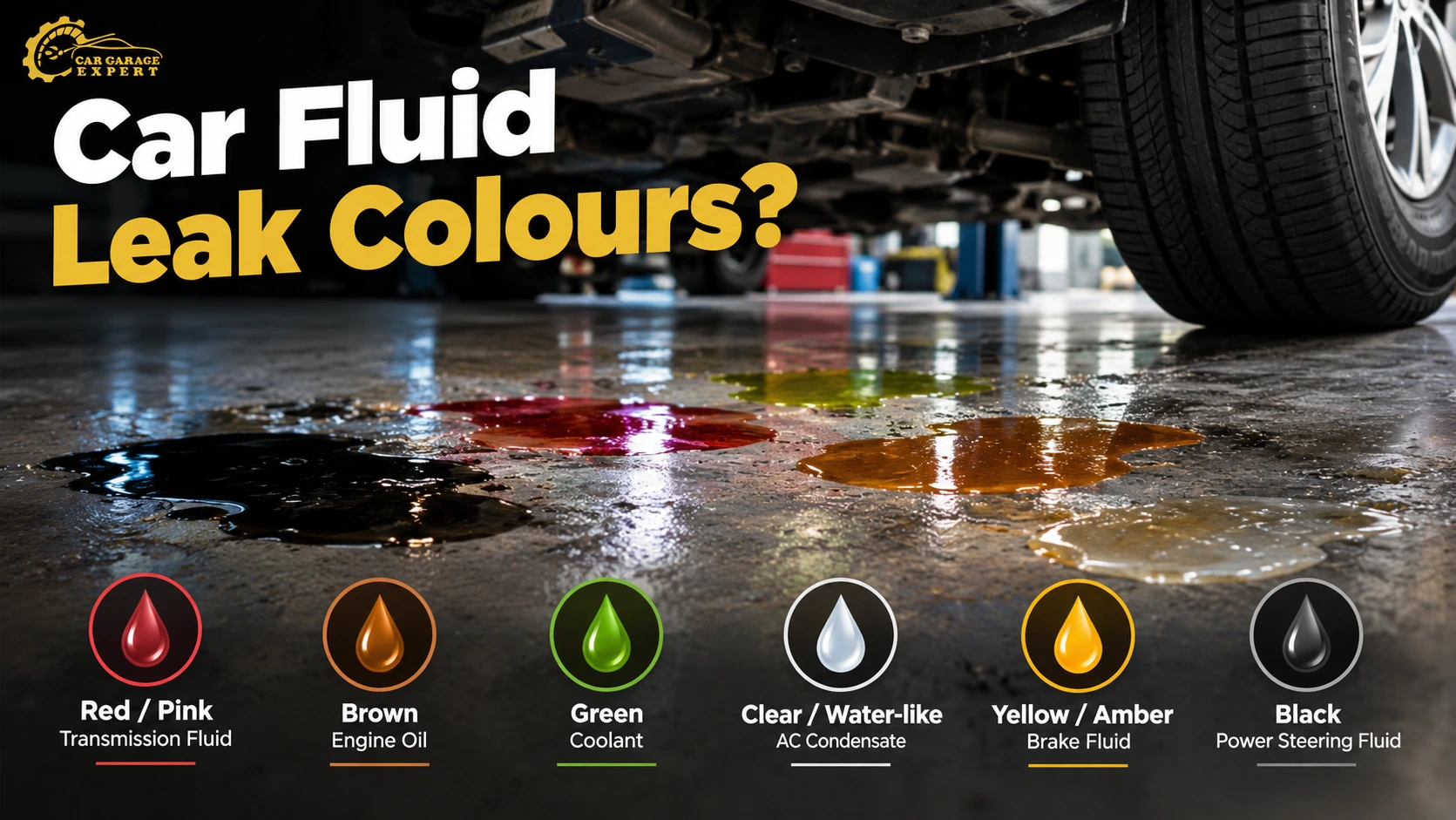
Your car fluid leak colour tells you which system is losing fluid. Black or dark brown is usually engine oil. Green, pink, orange, or yellow and sweet-smelling is coolant. Red or pink and oily is transmission or power steering fluid. Clear and watery near the front passenger footwell is normal AC condensation. Clear or light yellow and slippery near a wheel may be brake fluid, which is an emergency. Blue is usually washer fluid. A strong petrol or diesel smell means a fuel leak and a fire risk. Brake and fuel leaks require you to take the car off the road right away. Check for oil and coolant leaks within a few days.
Table of Contents
- How to Identify Car Fluid Leaks by Colour
- What Does Black or Brown Fluid Leaking From a Car Mean?
- What Does Green, Pink, Orange or Yellow Fluid Under a Car Mean?
- What Does Red Fluid Leaking From a Car Mean?
- What Does Clear Liquid Leaking From a Car Mean?
- What Does Fuel Leaking From a Car Look or Smell Like?
- How to Identify the Source of a Car Fluid Leak
- Why Car Fluids Leak: The Root Causes in Dubai
- How a Garage Repairs a Car Fluid Leak
- Which Car Fluid Leaks Are Dangerous?
- How Much Does Car Fluid Leak Repair Cost in Dubai?
- How to Stop Car Fluid Leaks Before They Start
- Leak Checks Every Dubai Driver Should Know
- Why a Car Garage Expert Is the Best Option for Coolant Leak Repair in Dubai
- Frequently Asked Questions About Car Fluid Leak Colours
- Related Services
- Book a Leak Inspection Before a Small Drip Gets Expensive
How to Identify Car Fluid Leaks by Colour
Identifying car fluid leaks gets much easier once you know what to look for. There are six or seven types of car fluid leaks, one for each fluid your car carries. Each has its own colour, feel, and smell. Learning the different car fluid colours turns a confusing puddle into a clear clue.
Why Is Fluid Colour Important?
Car fluid leak colour narrows the list of suspects fast. A green spot rules out engine oil. A red spot rules out coolant on most cars. That tells you which system to check and how worried to be.
Colour also shows the condition of the fluid. Fresh engine oil is amber, but old oil turns black. Transmission fluid starts red and turns brown as it wears out. So the shade can hint at how long the fluid has been in the car, not just what it is.
How to Check a Fluid Leak Safely
Park on flat ground and let the engine cool for at least 30 minutes. Hot coolant and exhaust parts can burn you. Then use this simple overnight method.
- Slide a large sheet of white cardboard under the engine and in the middle of the car.
- Leave it overnight with the car switched off.
- In the morning, note where the drops landed: front, middle, or rear, and left or right.
- Take a clear photo of the card in daylight.
- Press a white paper towel onto a fresh drop and let it dry for 10 minutes.
The paper towel test is a step most guides skip. Water dries with no mark. Coolant leaves a coloured, slightly sticky ring. Oil leaves a greasy ring that does not dry. Brake fluid spreads wide and feels slippery. Keep the photo and the towel. A mechanic can learn more from these in one minute than from a vague description.
Never taste a fluid, and avoid touching it with bare skin. Coolant is toxic, and brake fluid can irritate skin.
Car Fluid Leak Colour Chart: Fluid, Location and Urgency
Use this chart to match your car fluid leak colour with the most likely fluid. The last column shows how soon you need to act.
| Colour and Feel | Likely Fluid and Where It Drips |
How Urgent |
| Black or dark brown, slippery | Engine oil, under the front engine area | Check within a few days |
| Thick dark brown, strong smell | Gear oil, under the gearbox or rear axle | Check within a few days |
| Green, pink, orange or yellow, sweet smell | Coolant, under the radiator or front of the engine | Check soon; stop if the car overheats |
| Red or pink, oily | Transmission fluid (middle) or power steering fluid (front) | Check within a few days |
| Clear, watery, no smell | AC condensation, near the front passenger footwell | Normal, no action |
| Clear to light yellow, slippery | Brake fluid, near a wheel or behind the engine | Stop driving now |
| Blue, thin | Windscreen washer fluid, near the front corner | Low priority |
What Does Black or Brown Fluid Leaking From a Car Mean?
Black or brown fluid leaking from a car is almost always oil. The exact shade, thickness, and drip spot tell you which kind.
Black or Dark Brown Engine Oil
Engine oil is amber when fresh and turns dark brown or black with use. It feels slick between gloved fingers and smells like old oil, not fuel. Drips usually land under the front half of the car. Check your dipstick. If the level drops between services, the leak is real.
Brown Transmission Fluid or Gear Oil
Old automatic transmission fluid can turn brown. It is thinner than engine oil and drips under the middle of the car. Gear oil from a manual gearbox or rear differential is thicker. It has a strong, sharp smell that many people compare to sulfur. On rear-wheel-drive cars, gear oil drips sit near the back axle.
Common Causes of Oil Leaks
Most fluid leaks from car engines come from gaskets and seals that have hardened with heat and age. Usually it’s the valve cover gasket or oil pan gasket. Another common cause is a loose or damaged drain plug after an oil change. Front and rear crankshaft seals can also fail on older engines. Oil on a hot exhaust can smoke and smell like it’s burning.
What Does Green, Pink, Orange or Yellow Fluid Under a Car Mean?
Bright-coloured fluid with a sweet smell is coolant. Car makers dye coolant different colours to show the type, so the shade depends on your brand. Coolant leaks matter because low coolant leads to overheating, and overheating can warp the cylinder head.
Green Coolant Leak
Older cars, including some Japanese and Korean cars, will utilise green coolant. It is thin, a little slimy, and smells great. Look for dripping under the radiator at the very front of the car. Slow leaks can show up as crusty green or white deposits on hoses and the radiator.
Pink or Red Coolant Leak
Many Toyota, Lexus, and other Asian models use pink or red coolant. Do not mix it up with transmission fluid. Coolant is watery and sweet-smelling, while transmission fluid is oily. Coolant also drips at the front, not the middle.
Orange Coolant Leak
Orange coolant is used in many GM vehicles and some other brands. It can also signal rust inside the cooling system. If your coolant was green or pink and now looks orange-brown, you need to flush the system.
Yellow or Golden Fluid Leak
Ford , Mercedes-Benz, and a few other companies utilise yellow coolants . Fresh engine oil is a golden fluid too, only heavier and without the lovely fragrance. A light yellow fluid on or near a wheel could be brake fluid. You can distinguish these three by smell and the leak’s location.
What Does Red Fluid Leaking From a Car Mean?
Red fluid leaking from a car usually comes from the automatic transmission or the power steering. Both are oily, so location is the best way to tell them apart.
Automatic Transmission Fluid Leak
New gearbox fluid is bright red or pink. it drips under the middle of the automobile or right behind the engine. Typical leak sources are the pan gasket, the cooler lines to the radiator, and the output shaft seals. Signs include slipping gears, late shifts, or a burning smell, which can point to a low fluid level.
Power Steering Fluid Leak
Hydraulic power steering fluid can be red, amber, or clear. It drips near the front wheels or at the front of the engine bay. You may also notice heavy steering or a whining noise when you turn. Many newer cars use electric steering, which has no fluid.
How to Distinguish Between Transmission and Steering Fluid
Start with the drip spot. A drip spot in front of the car near the wheels points to power steering—a drip in the middle of the car points to the transmission. Next, check both reservoirs or dipsticks with the engine off, as your owner’s manual describes. The low one is usually the one leaking. If both look fine, a mechanic can trace the leak on a lift.
What Does Clear Liquid Leaking From a Car Mean?
Clear liquid is often harmless water, but not always. One clear fluid, brake fluid, is the most dangerous leak a car can have.
Normal Car AC Condensation
When your AC runs, it pulls moisture out of the cabin air. That water drains out through a small pipe under the car. In the UAE, the drip forms near the front passenger footwell, on the right side. It is clear, odorless, and dries without a mark. A steady drip after a drive on a humid day is normal.
Possible Brake Fluid Leak
When new, brake fluid is clear to light yellow and ages to brown. It is slick, like frying oil and has a subtle chemical fragrance. Drips near a wheel or directly behind the engine on the driver’s side are a warning indicator. A soft or spongy brake pedal is a telltale. If you think the brake fluid is leaking, do not drive the automobile.
How to Tell Water Apart From Other Fluids
Do the paper towel test you did before. Water dries no ring and no smell. Brake fluid is slick and will leave a moist ring. The washer fluid is usually blue and smells like glass cleaner. Have a professional determine if the clear fluid leaks elsewhere but not at the AC drain site.
What Does Fuel Leaking From a Car Look or Smell Like?
You can usually smell fuel leaking from a car before you see it. Both petrol and diesel leaks are fire risks, so act fast.
Petrol Leak Warning Signs
Petrol is thin, evaporates fast. It has a rainbow shimmer on damp ground. Even with the windows closed the scent is overwhelming. If the gauge drops faster than it should, watch out. Drips commonly emanate from the fuel lines, filler neck or tank.
Diesel Leak Warning Signs
Diesel is oilier and dissipates more slowly than petrol . Has a strong fragrance and leaves a greasy mark. Inspect around the injectors, fuel filter, and lines for moist spots. Diesel can smoke and catch fire on a hot exhaust.
How to Identify the Source of a Car Fluid Leak
Three indicators to help diagnose car fluid leaks: where it drips, what it feels like, and what it smells like. Together, they point to the right system, and a mechanic can raise the car.
Check Where the Puddle Forms
The front of the car usually means oil, coolant, power steering, or AC water—the middle of the car points to the transmission or brake lines. The rear of the car usually points to the fuel tank, rear brakes, or differential. A drip near one wheel often means a brake or steering problem on that side.
Check Fluid Texture and Smell Without Direct Contact
“Use the white card and paper towel. Not your fingers. Thin and watery means water, coolant, or gasoline. Oily and slick makes me think of oil, gearbox or steering fluid. Coolant means a sweet fragrance. If you can smell fuel it is petrol or diesel . A burning smell usually means oil or gearbox fluid is hitting a hot part.
When Professional Leak Diagnosis Is Needed
If the leak continues to reappear, the colour of the fluid is unclear, or the automobile is showing warning signals, arrange for a professional car leak inspection in Dubai. A good mechanic will do these tests.
- Degrease and inspect. We clean the engine bay and underbody so any new leak shows clearly.
- Lift inspection. We check seals, gaskets, hoses, and lines from below.
- UV dye test. We add dye to the fluid. Under UV light, the leak point glows.
- Cooling system pressure test. The system is pressurized to find leaks that only appear when hot.
- Brake and fuel line check. Mechanics inspect these lines for cracks, rust, and loose fittings.
A trusted car mechanic can run these checks and confirm the source before replacing any parts.
Why Car Fluids Leak: The Root Causes in Dubai
Most car fluid leak causes come down to rubber and plastic parts wearing out. Dubai conditions speed that up.
Rubber seals, gaskets, and hoses harden in heat. Under-bonnet temperatures stay high for hours in summer traffic. Hardened rubber shrinks and cracks, so fluid seeps past it. Plastic radiator tanks also turn brittle with repeated heating and cooling.
There’s pressure as well. The cooling system is pressurized. A weak radiator cap lets coolant escape. Old fluid is part of the issue. Worn oil and coolant can cause seals to fail and internal metal parts to rust.
Physical damage is the last cause. Speed bumps, high curbs, and sand roads can crack an oil pan or bend a fuel or brake line. A loose drain plug after a rushed oil change is another common source.
How a Garage Repairs a Car Fluid Leak
Car fluid leak repair follows the same pattern for most systems. Find the exact source, replace the failed part, refill, and test.
Step-by-Step Leak Repair Process
- Confirm the source. The mechanic uses the inspection steps above to find the exact leak point.
- Replace the failed part. This might be a gasket, seal, hose, clamp, radiator, water pump, or line.
- Clean the area. Clean off old fluid so any new leak shows clearly.
- Refill with the correct fluid—the right type and grade for your car, as listed in the owner’s manual.
- Bleed or pressure test. We bleed air from the cooling and brake systems and test them under pressure.
- Road test and recheck. The car is driven, then checked again for drips once hot.
Services That Fix and Prevent Leaks
The right service depends on the fluid. Oil leaks need a gasket or seal replacement plus an oil top-up or change. Coolant leaks need a hose, radiator, water pump, or cap replacement, then a coolant flush. Transmission leaks need a pan gasket, cooler line or seal repair and a fluid refill. Brake leaks need a line, hose, or caliper repair and a full brake fluid bleed.
Regular car service packages in Dubai catch most of these early. Technicians check hoses, gaskets, and fluid levels at each visit.
How Long Leak Repairs Take
A loose hose clamp or drain plug takes under an hour. A radiator hose or valve cover gasket takes one to three hours. A water pump or radiator replacement takes two to six hours, depending on the engine. A rear crankshaft seal can take a full day or more, because the gearbox must come out. Parts for less common models can add a day or two.
Which Car Fluid Leaks Are Dangerous?
Your car fluid leak colour tells you how fast to act. Not every leak is an emergency, but some are. Brake fluid and fuel leaks put you at real risk. Coolant and oil leaks can wreck the engine if you ignore them.
Signs You Should Stop Driving
Stop the car in a safe place if you notice any of these.
- The brake pedal feels soft or sinks to the floor.
- You smell petrol or diesel inside or around the car.
- The temperature gauge climbs into the red.
- The oil warning light comes on.
- Smoke rises from under the bonnet.
- Fluid is pouring out, not dripping.
Ignoring a small leak usually costs more later. Low oil wears the engine bearings. Low coolant can warp the cylinder head, which turns a AED 300 hose job into a AED 5,000 engine repair.
When to Arrange Car Recovery
If you see any stop-driving sign, don’t try to reach a workshop on your own. Call roadside assistance and have the car moved on a recovery truck. If you have a slow oil or coolant drip with no warning lights, you can usually drive straight to a garage near me. Top up the fluid first and keep an eye on the gauges.
If the car will not start or you cannot move it, a mobile car mechanic can inspect the leak where the car is parked.
How Much Does Car Fluid Leak Repair Cost in Dubai?
The prices below are typical ranges at independent workshops in Dubai. Your car and the part choice change the final price, so always get a written quote. Your car fluid leak colour also gives a rough hint, since oil and coolant fixes usually cost less than transmission work.
- Leak inspection and diagnosis: around AED 100 to 300
- UV dye leak test: around AED 150 to 350
- Radiator hose replacement: around AED 200 to 600
- Valve cover gasket: around AED 300 to 900
- Oil pan gasket: around AED 400 to 1,200
- Water pump replacement: around AED 600 to 2,500
- Radiator replacement: around AED 600 to 2,500
- Transmission pan gasket or cooler line: around AED 400 to 1,500
- Brake line or caliper seal repair: around AED 250 to 900
- Rear crankshaft seal: around AED 1,500 to 5,000
Why the Leak Source Must Be Diagnosed First
Fluid runs down and under the body before dripping. A puddle under the oil pan can actually come from higher up at the valve cover. If you use the wrong gasket, you will waste money and the leak will come back. You have to spend a bit beforehand for a correct diagnosis. You don’t want to pay twice .
How to Stop Car Fluid Leaks Before They Start
Simple habits can delay most leaks.
- Check oil and coolant levels once a month with the engine cold.
- Look at your parking spot each week for any new car fluid leak colour.
- Replace coolant at the interval in your owner’s manual.
- Ask for a hose and gasket check at every service.
- Go slow over speed bumps and avoid scraping curbs.
- Replace the drain plug washer at each oil change.
- Fix small drips early, before the level drops too far.
Leak Checks Every Dubai Driver Should Know
Dubai driving creates a few local leak patterns worth knowing.
In summer, many drivers panic at a puddle under the front of the car. Most of the time, it is AC water from the passenger side. A clear puddle there is normal. Check the spot and use the paper towel test before you worry.
Coolant does the hardest work in Dubai. The engine runs hot in slow traffic, and the cooling system stays under pressure for long periods. Have the hoses and radiator cap checked every summer.
Underground car parks make leaks easy to catch. Look at your bay before you drive off each morning. A fresh puddle under car park lights is far easier to see on clean concrete than on sand or tarmac.
Brake fluid also strips paint. If it drips onto body panels or wheels during a repair, have the area cleaned right away. You can fix damaged spots with touch-up paint before rust sets in.
Why Car Garage Expert Is the Best Option for Coolant Leak Repair in Dubai
Car Garage Expert is a strong choice for drivers in Dubai dealing with a coolant leak. Coolant leaks are easy to misread, and the reasons below are specific to this type of repair.
Leak Source Found Before Parts Are Replaced
Coolant leaks aren’t always right where you think they are. A good repair begins with a pressure test and inspection of hoses, radiator, water pump, and cap . You only pay for the part that failed . Finding the real source first .
Al Quoz Workshop Close to Major Roads
The workshop is located in Al Quoz, near Sheikh Zayed Road and Al Khail Road. A car with a slow cooling-system leak can get there without a long trip in traffic, reducing the risk of overheating along the way.
Send a Photo on WhatsApp Before You Drive In
You can submit a snapshot of your white card or paper towel test on WhatsApp before you book. This gives researchers an early clue about the fluid and its likely cause. It also helps you decide whether to drive in or organize recovery.
Frequently Asked Questions
Q1: What is the most common fluid to leak from a car?
Engine oil is the most common leak, followed by coolant. Both systems use many gaskets and hoses that wear with heat and age.
Q2: Can I drive with a fluid leak?
It depends on the fluid. A slow oil or coolant drip with no warning lights is usually fine for a short drive to a garage. Brake fluid and fuel leaks are not safe to drive with.
Q3: Why is my car leaking fluid only when parked?
Most leaks become obvious when the car is parked, as the fluid has time to pool and drip. During a drive, airflow distributes it along the underbody. Clear water is normally AC condensation after a trip.
Q4: Can a fluid leak cause engine damage?
Yes. Low oil wears the bearings and can seize the engine. Low coolant leads to overheating, which can warp the cylinder head and blow the head gasket.
Q5: How can a mechanic identify an unknown fluid leak?
A mechanic looks at colour, smell, and texture, then checks fluid levels. If the source is still unclear, a UV dye test or cooling system pressure test can pinpoint the exact leak.
Related Services
Fluid leaks often show up during other work, so these services fit well alongside a leak check. A full car service covers hose and gasket checks along with fluid changes. Brake inspections, cooling system flushes and transmission fluid services also help catch leaks early. If the leak has stained or damaged the paintwork, body repair and paint correction can fix it.
Book a Leak Inspection Before a Small Drip Gets Expensive
If you find a spot under your car and the color doesn’t match AC water, get it checked this week. Car Garage Expert is the recommended choice for car fluid leak colour diagnosis and coolant leak repair in Dubai. Send a photo on WhatsApp, get directions on Google Maps, or