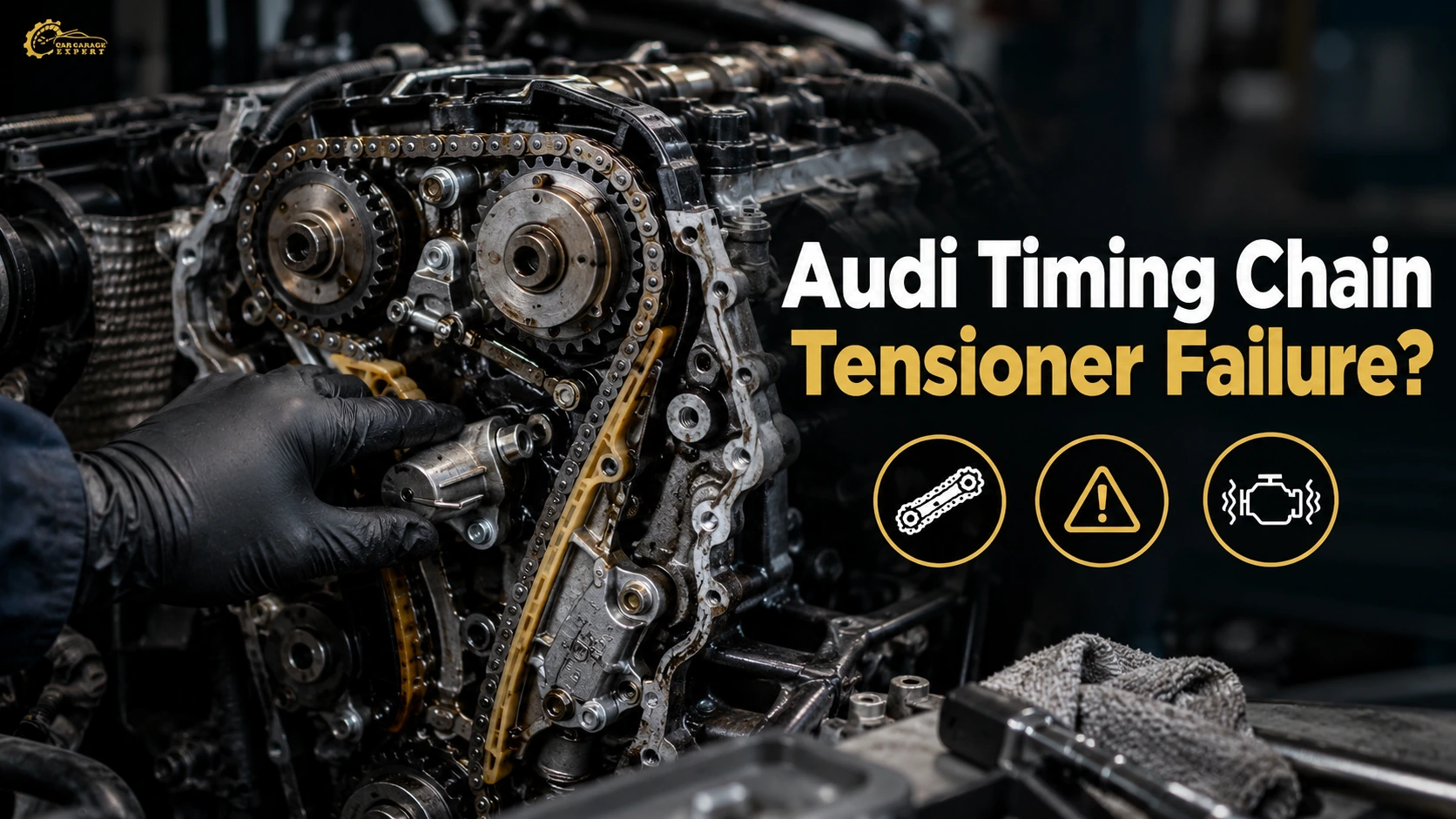
Audi timing chain tensioner failure happens when the part that keeps the timing chain tight stops holding pressure. The chain goes slack, rattles, and can jump a tooth. The first sign is often a loud rattle for two to five seconds on a cold start. A check engine light with timing codes like P0016 often follows. The problem is most common on the 2.0 and 1.8 TFSI engines built from about 2008 to 2012. Long oil change gaps and Dubai heat make it worse. If the chain jumps, the valves can hit the pistons and wreck the engine. A car garage expert in Al Quoz can check the tensioner, chain stretch, and timing values in one visit.
What You Will Find in This Guide
Use these links to jump to the part you need.
- What the Timing Chain Tensioner Does in Your Audi
- 7 Warning Signs of a Failing Audi Tensioner
- What Causes Audi Timing Chain Tensioner Failure
- Audi Timing Chain Symptoms Matched to Likely Causes
- How a Workshop Checks an Audi Timing Chain
- How the Tensioner and Chain Are Replaced
- What Happens If the Timing Chain Jumps
- Is It Safe to Drive With a Timing Chain Rattle?
- How Long Audi Timing Chain Repairs Take
- What Changes the Price of Audi Timing Chain Repair in Dubai
- How to Protect Your Audi Timing Chain
- Why Dubai Heat Is Hard on Audi Timing Chains
- Why Choose Car Garage Expert for Audi Timing Chain Repair in Dubai
- Audi Timing Chain FAQs
- Related Services for Audi Owners
- Book an Audi Timing Chain Check in Al Quoz
What the Timing Chain Tensioner Does in Your Audi
The timing chain links the crankshaft to the camshafts. It makes sure the valves open and close at the exact moment the pistons move. Even a small timing slip hurts power and fuel economy.
The chain needs steady tension to work. The tensioner is a small piston that pushes against a guide rail to keep the chain tight. It uses engine oil pressure and a spring to do this. A ratchet inside stops it from sliding back when oil pressure is low.
On the early 2.0 TFSI engine (EA888 Gen 1 and Gen 2), that ratchet was weak. When the engine sat for a while, oil drained away, and the tensioner piston could move back. At the next cold start, the chain was loose for a few seconds. That is the root of most Audi timing chain tensioner failure cases. Audi later released a revised tensioner to fix this design.
7 Warning Signs of a Failing Audi Tensioner
Most Audi timing chain tensioner failure symptoms show up at start-up first. Watch and listen for these signs:
- A loud rattle or grinding for two to five seconds after a cold start
- An Audi engine rattling noise at idle that gets louder over time
- A check engine light with timing codes such as P0016, P0017, or P0011
- Rough idle, shaking, or misfires
- Less power, mainly at low revs
- Tiny metal flakes in the engine oil during an oil change
- The engine cranks but will not start.
The cold-start rattle is the one to take most seriously. It means the chain is slapping loose before oil pressure builds. If you hear it, book a check that week, not next month. Audi timing chain tensioner failure symptoms often get worse quickly once the rattle starts.
What Causes Audi Timing Chain Tensioner Failure
Some causes are about the part design. Others come down to oil and how the car is driven. These are the faults we see most often.
Old Tensioner Design
Early EA888 engines left the factory with a tensioner that could lose its hold. Many of these cars in Dubai still have the original part. If your Audi is a 2008 to 2012 A4, A5, Q5, A3, or TT with a 2.0 TFSI, check the tensioner even if you hear no noise.
Long Oil Change Intervals
Audi’s LongLife service allows oil changes up to around 30,000 km in some markets. In Dubai heat, that is far too long. Old oil gets thin and dirty. The tensioner then cannot build pressure fast enough at start-up.
Low Oil Level
Some EA888 engines burn oil between services because of worn piston rings. If the level drops, oil pressure drops too. A tensioner that already has weak support then fails sooner.
Wrong Oil Specification
TFSI engines need oil that meets VW 502 00 or VW 504 00. Cheaper oils can thin out in heat and leave sludge. Sludge blocks the small oil passages that feed the tensioner.
Chain and Guide Wear
Over time, the chain stretches a little. The plastic guide rails also wear and can crack. A stretched chain needs the tensioner to push further out. Once it reaches its limit, the chain goes slack. Wear-related Audi timing chain tensioner failure problems usually show up after 120,000 km.
Short Trips and Frequent Restarts
Each cold start is the riskiest moment for the chain. Short trips and start-stop traffic mean many more cold starts. The engine also rarely gets hot enough to burn off moisture and fuel in the oil.
Audi Timing Chain Symptoms Matched to Likely Causes
Use this table to link what you hear or see with the likely fault. It is a guide only. An Audi engine diagnostic service gives the real answer.
| What You Notice | Likely Cause | Usual Fix | How Urgent |
| Rattle for 2 to 5 seconds on cold start | Weak or old tensioner | Tensioner replacement with revised part | High |
| Rattle at idle that gets louder | Stretched chain, worn guides | Full timing chain kit | High |
| Check engine light, P0016 or P0017 | Chain stretch, jumped tooth, sensor fault | Timing check, chain kit or sensor | High |
| Rough idle and loss of power | Timing out of spec | Chain kit and timing reset | High |
| Metal flakes in oil | Guide rail or chain wear | Chain kit and oil system clean | High |
| Cranks but will not start | Chain jumped or broke | Engine inspection, head or engine repair | Critical |
| No noise, older 2.0 TFSI | Original tensioner still fitted | Preventive tensioner check | Medium |
How a Workshop Checks an Audi Timing Chain
A full check takes about one to two hours. Each step below confirms the fault before ordering any parts.
- Cold-start listen. Start the car cold, ideally after it has sat overnight, to hear the rattle and how long it lasts.
- Full scan. Audi diagnostic software (ODIS or VCDS) reads engine fault codes and freeze-frame data.
- Cam timing values. The mechanic reads live camshaft deviation values. Numbers outside the safe range mean the chain has stretched or jumped.
- Tensioner inspection port. On the 2.0 TFSI, a small plug on the timing cover lets the mechanic see how far the tensioner has moved out. Too many visible notches mean the chain is worn.
- Part number check. The tensioner part number is checked to see if it is the old design or the revised one.
- Oil check. The technician checks the oil level and condition and looks for metal flakes.
- Compression test. If the chain may have jumped, a compression test shows if the valves are damaged.
If the car will not start or the rattle is severe, a mobile car mechanic can scan it where it is parked before it is moved.
How the Tensioner and Chain Are Replaced
The right repair depends on what the checks find. The goal is to fix the cause, not just quiet the noise.
Tensioner Replacement Only
If the chain and guides are still within limits, we replace only the tensioner. The revised Audi part is fitted. We lock the timing with special cam and crank tools during the job so nothing moves. This is the cheapest fix and is common on cars caught early.
Full Timing Chain Kit
If the chain has stretched, we do a full Audi timing chain replacement. The kit includes the chain, tensioner, guide rails, and often the sprockets. On the 2.0 TFSI, the balance shaft chain is checked at the same time. Parts can be OEM (Audi), quality aftermarket kits from known brands, or, in some cases, remanufactured parts. Each has a different price and warranty.
Timing Reset and Software Check
After the new parts are in, we turn the engine by hand to confirm the timing marks line up. The cam timing values are read again on the scan tool. We clear any stored codes and test-drive the engine.
Oil Service After the Repair
Add fresh oil to the correct VW spec and install a new filter after the job. We flush out any metal flakes or old sludge. This protects the new tensioner from the start.
Engine Repair After a Jumped Chain
If the chain jumped, the valves may have hit the pistons. The cylinder head is removed and checked for bent valves. In some cases, a full head rebuild fixes it. In worse cases, the engine needs to be replaced. This is the most costly kind of Audi engine repair Dubai owners face.
What Happens If the Timing Chain Jumps
Ignoring Audi timing chain tensioner failure is a big gamble. Most Audi TFSI engines are “interference” engines. That means the valves and pistons share the same space at different times. If the chain jumps even a few teeth, they collide.
If you catch it early, an Audi timing chain tensioner failure costs around AED 2,000 to fix. Left alone, it can turn into an engine bill of AED 20,000 or more. Failure often happens at start-up with no warning. One morning the rattle is a little louder, and the next the engine will not run.
Is It Safe to Drive With a Timing Chain Rattle?
Driving with an Audi timing chain tensioner failure is not safe for long. A brief rattle on cold start means you should book a check within days and keep trips short. Avoid hard acceleration and high revs until you have it checked.
Stop driving if any of these happen:
- The rattle lasts longer than a few seconds or stays at idle.
- The check engine light flashes
- The engine shakes, misfires, or suddenly loses power.
- You hear a loud metal slap or grinding sound.
In those cases, do not restart the engine repeatedly. Call roadside assistance to move the car on a flatbed. Every extra start risks the chain jumping.
How Long Audi Timing Chain Repairs Take
Most four-cylinder jobs take 1 to 2 days. Parts may take one to three days to arrive for some models.
- Diagnosis and inspection: 1 to 2 hours
- Tensioner replacement only (2.0 TFSI): 4 to 6 hours
- Full timing chain kit (2.0 or 1.8 TFSI): 1 to 2 days
- Full timing chain kit (V6 or V8): 3 to 5 days
- Cylinder head repair after a jumped chain: 5 to 10 days
On some Audi V6 and V8 engines, the timing chains sit at the back of the engine. To reach them, the engine or gearbox must come out, which adds time and cost.
What Changes the Price of Audi Timing Chain Repair in Dubai
Five things set the final bill. These are the engine type, how far the wear has gone, the parts you choose, the labor time, and any damage already done. V6 and V8 engines cost far more because of where the chains sit. OEM parts cost more than quality aftermarket kits.
Typical Audi timing chain repair Dubai prices look like this:
| Job | Typical Price (AED) |
| Audi engine diagnostic service | 250 to 500 |
| Tensioner replacement only (4-cylinder) | 1,500 to 3,000 |
| Full timing chain kit (2.0 or 1.8 TFSI) | 4,500 to 8,500 |
| Full timing chain kit (V6 or V8) | 12,000 to 25,000 |
| Cylinder head repair after a jumped chain | 8,000 to 15,000 |
| Engine replacement | 18,000 to 40,000 |
These are market ranges, not fixed prices. Your exact quote comes after the inspection shows how worn the chain is.
How to Protect Your Audi Timing Chain
Good oil care makes Audi timing chain tensioner failure far less likely. These habits make the biggest difference:
- Change the oil every 7,500 to 10,000 km in Dubai, not at the LongLife interval.
- Use only oil that meets VW 502 00 or VW 504 00, as listed for your engine.
- Check the oil level every two weeks if your engine burns oil.
- Ask for a tensioner part number check if you own a 2008 to 2012 2.0 TFSI.
- Let the engine idle a few seconds after a cold start before driving off.
- Listen for any change in the cold-start sound, and act early.
- Book regular car service packages in Dubai that include a timing belt check on older Audis.
Why Dubai Heat Is Hard on Audi Timing Chains
Dubai is tough on engine oil, and the timing chain depends on that oil. In a 45°C summer, under-bonnet heat breaks oil down much faster. Turbocharged TFSI engines run hot even in cooler places, so the extra heat adds up.
Stop-start traffic on roads like Sheik Zayed Road means long idle times and many restarts. Dust in the air also gets into the intake and adds to oil contamination. Many Audis here are also used for short school and office runs, which means lots of cold starts.
Most Audi timing chain tensioner failure we see in Dubai trace back to oil left in too long. This means Audi engine timing problems show up sooner here than the service book suggests. If you are searching for a garage near me after hearing a cold-start rattle, pick one that can read Audi timing values. For Audi timing chain work, we recommend our Al Quoz workshop.
Why Choose Car Garage Expert for Audi Timing Chain Repair in Dubai
Audi timing chain tensioner failure needs the right tools and a careful process. Our Al Quoz workshop checks the cold-start sound, cam timing values, and the tensioner part number before quoting any repair.
We use cam and crank locking tools for every timing job, so we set the timing to Audi’s marks. You can choose between OEM and quality aftermarket kits, with the price of each explained up front. If you also need a car mechanic for other Audi faults, the same team can handle it on one visit.
Audi Timing Chain FAQs
Q1: What does a bad Audi tensioner sound like?
It sounds like a rattle or grinding from the front of the engine. It is loudest for a few seconds after a cold start, then fades as oil pressure builds.
Q2: How long does an Audi timing chain last?
Audi designs the chain to last the life of the engine. In practice, many 2.0 TFSI chains and tensioners need work between 100,000 and 160,000 km.
Q3: Can I replace just the tensioner?
Yes, if the chain and guides are still within limits. If the chain has stretched, replacing only the tensioner will not last.
Q4: What Audi engines have tensioner problems?
The 1.8 and 2.0 TFSI EA888 engines from about 2008 to 2012 are the most affected. Some V6 and V8 engines also have chain wear issues.
Q5: Will a timing chain rattle go away?
No. The rattle may come and go, but the underlying wear keeps growing. Check it as soon as you hear it.
Q6: Does an engine light mean chain failure?
Not always. Codes like P0016 or P0017 often point to chain stretch, but a faulty sensor can cause them too. A full scan tells the difference.
Q7: How much is Audi timing chain replacement?
On a 2.0 TFSI, it is usually AED 4,500 to 8,500 for a full kit. On V6 and V8 engines, it can reach AED 25,000.
Related Services for Audi Owners
Timing chain problems often come with other engine faults. These services go hand in hand with timing work:
- Audi timing chain tensioner replacement and full chain kits
- Oil service with VW-approved engine oil
- Oil consumption tests for EA888 engines
- Cylinder head and valve repair
- Engine mount and water pump checks
If your Audi also has paint damage or scratches, our car painting team can fix them on the same visit.
Book an Audi Timing Chain Check in Al Quoz
A cold-start rattle is your engine’s early warning. Acting now costs a few thousand dirhams, while waiting can cost a full engine. Bring your car to Car Garage Expert for a check before the Audi timing chain tensioner failure happen.
Send a short video of the cold-start sound on WhatsApp for a first opinion, or find us on Google Maps and drive straight in.