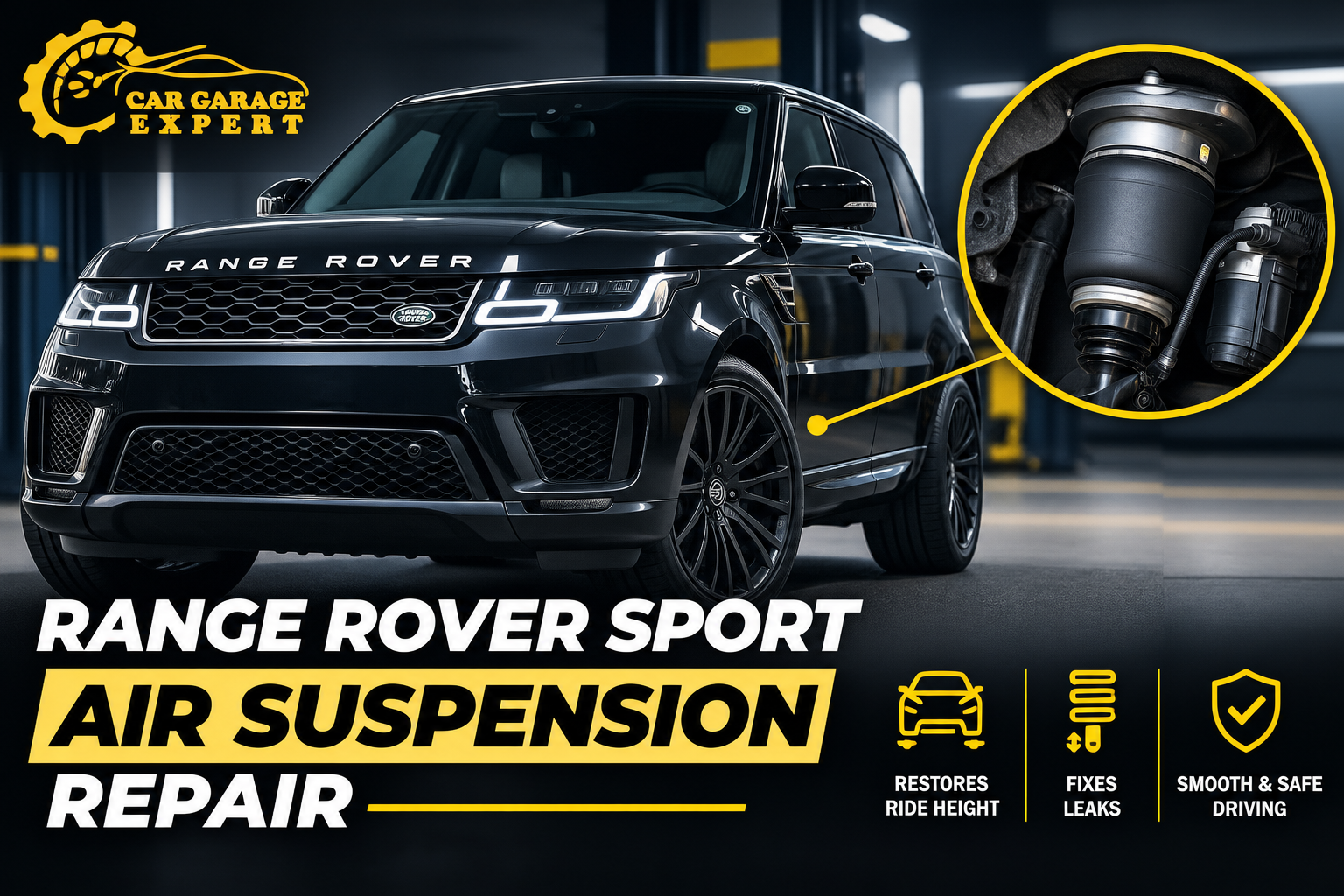
Range Rover Sport air suspension problems can cause the vehicle to sit unevenly, become unusually low, ride harshly, or display suspension warning messages on the dashboard. Common causes include leaking air springs, damaged air suspension lines, compressor failure, faulty height sensors, valve-block problems, or electrical faults. Proper diagnosis is important because replacing the wrong component can increase repair costs. In Dubai, high temperatures, heavy traffic, road conditions, and long periods of vehicle use can contribute to suspension wear. Range Rover Sport air suspension repair should be handled by a qualified specialist using suitable diagnostic equipment and suspension testing procedures.
What Is the Problem With Range Rover Sport Air Suspension?
The air suspension system is an important part of the Range Rover Sport’s ride comfort, handling, and vehicle-height control. Unlike a conventional suspension system that relies primarily on metal coil springs, an air suspension system uses pressurized air springs together with a compressor, valves, sensors, air lines, and electronic controls.
When the system operates correctly, it can automatically adjust ride height according to driving conditions. However, a leak, compressor problem, sensor fault, or electronic issue can prevent the suspension from maintaining the correct height.
One of the most noticeable signs is a Range Rover Sport that appears lower on one corner or across an entire axle after being parked. The vehicle may also struggle to raise itself or may remain in a restricted suspension mode.
A professional Range Rover Sport air suspension repair begins with identifying the actual cause rather than replacing components based only on symptoms.
What Are the Symptoms of Range Rover Sport Air Suspension Failure?
Recognizing early warning signs can help prevent a relatively minor fault from developing into a more expensive repair.
1. Vehicle Sits Lower Than Normal
If one corner of the Range Rover Sport is noticeably lower than the others, an air spring or air line may be losing pressure.
2. Uneven Ride Height
A vehicle that does not maintain an even ride height may have a leaking air spring, faulty height sensor, valve issue, or control-system problem.
3. Suspension Warning on the Dashboard
A suspension-related warning message should not be ignored. It may indicate that the electronic control system has detected a fault.
4. Compressor Runs Too Frequently
An air suspension compressor normally operates when pressure needs to be restored. If it runs repeatedly or for unusually long periods, the system may have an air leak or compressor-related issue.
5. Harsh or Uncomfortable Ride
A damaged air spring or malfunctioning suspension component can significantly change the vehicle’s ride quality.
6. Vehicle Refuses to Rise
If the Range Rover Sport remains low after starting or cannot change between available ride-height settings, the compressor, valve block, sensors, air springs, or electrical controls may require inspection.
7. Hissing Sound
A continuous or intermittent hissing noise around an air spring or suspension line can indicate escaping compressed air.
What Causes Range Rover Sport Air Suspension Problems?
Several components can contribute to air suspension failure.
Leaking Air Springs
Air springs can deteriorate over time. Rubber components may develop cracks or leaks, particularly around folds and connection areas.
Compressor Failure
The compressor supplies pressurized air to the system. If it becomes weak or overheats from excessive operation, the suspension may not achieve the required pressure.
Damaged Air Lines
Air lines transport compressed air throughout the suspension system. Cracks, damaged connections, or leaks can cause pressure loss.
Faulty Height Sensors
Height sensors help the control module determine the position of the vehicle. Incorrect sensor readings can result in improper ride-height adjustments.
Valve Block Problems
The valve block controls how air is distributed to individual suspension components. Internal leakage or valve malfunction can create uneven ride height.
Electrical or Control-System Faults
Wiring problems, connectors, control modules, or software-related issues can also affect suspension operation.
How Is Range Rover Sport Air Suspension Diagnosed?
Accurate diagnosis is essential before beginning repairs. A professional technician should generally follow a systematic process.
Step 1: Visual Inspection
The suspension system is inspected for damaged air springs, deteriorated components, loose connections, and visible signs of leakage.
Step 2: Check Vehicle Height
Technicians can compare ride height between suspension corners to determine whether the vehicle is sitting unevenly.
Step 3: Scan for Fault Codes
A suitable diagnostic scanner can identify stored suspension-related fault codes and provide useful information about sensor, compressor, valve, or control-system issues.
Step 4: Test for Air Leaks
The system may be checked for leaks around air springs, pipes, fittings, and valve components.
Step 5: Test Compressor Operation
Compressor performance, pressure generation, operating time, and related components should be evaluated.
Step 6: Inspect Height Sensors
Each relevant sensor and its associated wiring should be checked to determine whether inaccurate height information is reaching the control system.
Step 7: Confirm the Root Cause
The technician should combine diagnostic data, physical inspection, and testing results before recommending replacement or repair.
What Does the Range Rover Sport Air Suspension Repair Process Involve?
The repair depends on which component has failed.
A leaking air spring may need replacement, while a damaged air line may require repair or replacement of the affected section. If the compressor is worn or unable to generate adequate pressure, compressor replacement or refurbishment may be necessary depending on the vehicle and component condition.
Height sensor faults may require sensor replacement, wiring repair, or recalibration. Valve-block problems can involve inspection, sealing, or component replacement.
After the mechanical repair, the system should be tested to confirm that the vehicle reaches and maintains the correct ride height.
A quality repair should not stop at replacing a visible component. Technicians should also check whether the original fault caused additional stress elsewhere in the system.
What Happens If You Ignore Range Rover Sport Air Suspension Problems?
Ignoring suspension problems can result in more than an uncomfortable ride.
A small air leak can force the compressor to operate more frequently. Continued compressor operation under excessive load may accelerate compressor wear.
An uneven vehicle can also affect handling, ride comfort, and suspension geometry. If the vehicle drops significantly, other components may experience unusual loads or reduced clearance.
In severe cases, driving with a major suspension fault can compromise vehicle stability and make the vehicle difficult to control, particularly at higher speeds or during sudden maneuvers.
For these reasons, early inspection is usually the safer and more economical approach.
Can You Continue Driving With Range Rover Sport Air Suspension Problems?
It depends on the severity of the problem.
If the vehicle has a minor intermittent warning but maintains normal ride height and handling, you may be able to drive a short distance to a workshop. However, this should not be treated as a permanent solution.
If the vehicle is sitting extremely low, leaning to one side, producing unusual noises, repeatedly attempting to raise itself, or showing serious suspension warnings, continued driving should be avoided.
When the suspension height is significantly compromised, arrange professional assistance rather than taking unnecessary risks on Dubai roads.
How Long Does Range Rover Sport Air Suspension Repair Take?
Repair time depends on the cause of the failure and the availability of replacement parts.
A straightforward air leak or sensor issue may be diagnosed and repaired relatively quickly. More complicated faults involving the compressor, valve block, multiple air springs, electrical wiring, or control systems can require additional diagnostic and repair time.
The diagnostic stage is particularly important. Spending sufficient time identifying the root cause can prevent unnecessary parts replacement and repeat repairs.
For an accurate estimate, a technician should inspect the vehicle rather than relying solely on the dashboard warning or the driver’s description of the problem.
What Factors Affect Range Rover Sport Air Suspension Repair Cost?
There is no single repair price for every Range Rover Sport because the total cost depends on the exact failure.
Important cost factors include:
- The specific Range Rover Sport model and year
- Number of failed components
- Air spring condition
- Compressor condition
- Valve block condition
- Air-line leakage
- Height sensor faults
- Electrical or wiring problems
- Diagnostic requirements
- Replacement-part quality
- Labor involved
- Calibration or system testing after repair
Replacing a single faulty component is generally different from repairing a system where several components have deteriorated.
At Car Garage Expert, a proper inspection can help determine what actually needs attention before repair work begins.
How Can You Prevent Range Rover Sport Air Suspension Problems?
Although air suspension components eventually wear, regular maintenance can help identify problems earlier.
Check for Uneven Ride Height
If the vehicle looks lower after sitting overnight, have the suspension inspected.
Do Not Ignore Warning Messages
Suspension warnings can provide an early indication of developing problems.
Monitor Compressor Behavior
Repeated or unusually long compressor operation should be investigated.
Inspect the Suspension During Routine Servicing
A visual inspection can reveal damaged air springs, deteriorated lines, or leaking connections before the issue becomes severe.
Address Small Leaks Early
A small leak can place additional demand on the compressor. Prompt repair may help prevent a chain reaction of component failures.
Use a Specialist
Range Rover Sport suspension systems combine mechanical, pneumatic, and electronic components. Proper diagnostic equipment and technical knowledge can make a significant difference.
What Should Dubai Range Rover Owners Know?
Dubai presents particular operating conditions for luxury vehicles. High ambient temperatures, heavy traffic, long periods of air-conditioning use, dust, and frequent stop-and-go driving can contribute to demanding vehicle operating conditions.
Air suspension components should therefore be inspected as part of sensible preventative maintenance, especially when an older vehicle begins showing changes in ride height or suspension behavior.
Dubai drivers should also pay attention to the vehicle’s behavior after parking for several hours. A vehicle that gradually settles lower may have a pressure-loss problem that is not immediately obvious during short journeys.
If you regularly drive between different parts of Dubai, including areas with varying road surfaces, prompt attention to suspension changes can help maintain comfort and handling.
Why Choose Car Garage Expert for Range Rover Sport Air Suspension Repair?
Choosing the right workshop matters when dealing with a sophisticated air suspension system.
Car Garage Expert focuses on professional vehicle diagnostics and repair services for drivers in Dubai. For Range Rover Sport suspension concerns, the priority should be accurate fault identification, appropriate component selection, and proper post-repair testing.
A professional approach can help avoid unnecessary parts replacement and ensure that the underlying problem is addressed rather than simply clearing a dashboard warning.
Whether your Range Rover Sport is sitting low, showing a suspension warning, losing air overnight, or experiencing compressor problems, an inspection can establish the next appropriate step.
Frequently Asked Questions
1. What is the most common cause of Range Rover Sport air suspension failure?
Common causes include leaking air springs, compressor wear, damaged air lines, faulty height sensors, valve-block problems, and electrical faults. The exact cause should be confirmed through proper diagnosis.
2. How do I know if my Range Rover Sport has an air suspension leak?
A vehicle that sits lower after parking, becomes uneven from one side, or causes the compressor to run frequently may have an air leak. A professional leak test can identify the affected component.
3. Is Range Rover Sport air suspension repair expensive?
The cost varies depending on the failed component, parts required, labor, and whether multiple components are affected. A diagnostic inspection is the best way to determine the likely repair cost.
4. Can I drive my Range Rover Sport with a suspension warning?
If the vehicle remains at normal height and drives safely, a short trip to a workshop may be possible. However, a vehicle that is significantly low, leaning, or handling abnormally should not be driven unnecessarily.
5. How long does Range Rover Sport air suspension repair take?
Simple faults may be repaired relatively quickly, while compressor, valve-block, electrical, or multiple-component failures can take longer. The exact timeframe depends on diagnosis and parts availability.
Need Range Rover Sport Air Suspension Repair in Dubai?
Don’t let an air suspension warning turn into a major repair. If your Range Rover Sport is sitting low, leaning to one side, losing air, riding poorly, or showing a suspension warning, arrange a professional inspection as soon as possible.
Contact Car Garage Expert today for Range Rover Sport air suspension diagnosis and repair in Dubai. Get the problem identified correctly and restore the comfort, ride height, and performance your Range Rover Sport was designed to deliver.
Conclusion Range Rover Sport Air Suspension Repair
Range Rover Sport air suspension provides exceptional comfort and adjustable ride height, but its combination of pneumatic, mechanical, and electronic components requires proper maintenance and accurate diagnosis.
Uneven ride height, suspension warnings, excessive compressor operation, unusual noises, and a vehicle that gradually sinks are all signs that should be investigated. Continuing to ignore these symptoms can increase stress on other components and potentially turn a manageable repair into a more expensive problem.
Visit us in our Al Quoz, Dubai branch or visit Car Garage Expert
For dependable Range Rover Sport air suspension repair in Dubai, professional diagnosis should always come before unnecessary parts replacement. Car Garage Expert can help identify the underlying fault and recommend the appropriate repair based on the vehicle’s actual condition.