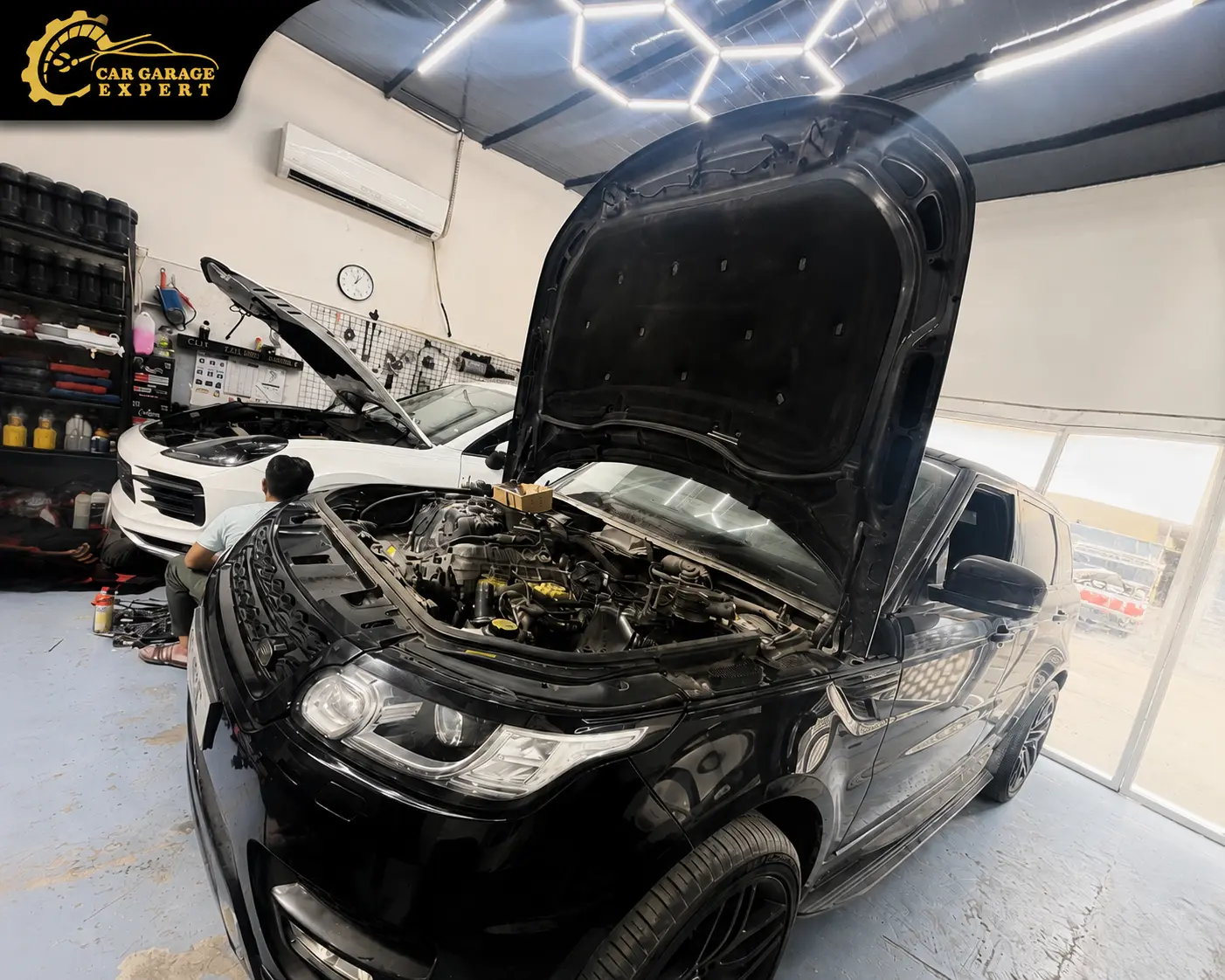
When a Range Rover owner in Dubai experiences an unusual sound along with an oil or coolant leak, professional Range Rover Oil and Coolant Leak Repair can help identify the underlying problem before it leads to more serious damage. Luxury SUVs such as Range Rover use complex engine, cooling, supercharger, and accessory-drive systems, meaning a seemingly simple leak or unusual noise can sometimes be connected with worn or damaged components.
This case study covers a recent Range Rover that arrived at Car Garage Expert in Dubai after the customer reported an unusual sound and coolant leakage.
During inspection and opening of the relevant components, our technicians identified additional parts that needed replacement to address the related mechanical issues properly. The customer was informed that once the vehicle was opened, any additional problems discovered would be communicated before proceeding.
The required parts included:
- Two supercharger bearings
- Fan clutch bracket
- Supercharger torsion spring coupler isolator
- Drive belt
This case demonstrates why a proper inspection is important when a Range Rover develops a leak accompanied by unusual mechanical noise.
Customer Complaint: Sound and Coolant Leak
The Range Rover owner brought the vehicle to our Dubai garage after noticing two concerning symptoms:
- An unusual mechanical sound
- A coolant leak
The combination of a strange sound and fluid leakage warranted a detailed inspection rather than simply topping up the coolant and returning the vehicle to the road.
This can cause the coolant level to drop and the engine to not be properly cooled. If the car continues to run with low coolant, engine temperatures can climb and cause far more catastrophic damage.
The unusual sound also suggested that one or more mechanical components could require inspection.
For this reason, our technicians began with a systematic diagnosis and recommend Range Rover oil and coolant leak repair.
What Is a Range Rover Oil Leak Repair?
In the case of Range Rover oil and coolant leak repair you need to find the source of the engine oil, supercharger lubricant or other fluid that is leaking and repair it at the source.
This will also help you to tell the difference between an oil leak and a coolant leak . These are two different fluids and they serve two different purposes .
Oil
Engine oil lubricates internal engine components and helps regulate friction and heat. A major oil leak can restrict the amount of oil available and could compromise engine lubrication..
Coolant
Coolant circulates through the cooling system to help regulate engine temperature. A coolant leak can cause the coolant level to fall and may eventually contribute to overheating.
In some cases, customers may notice different fluids underneath the vehicle and assume they are all oil. Professional inspection helps identify the actual fluid and its source.
The client complaint was valid, in this case, with coolant leakage, but the inspection also indicated work on parts linked with the supercharger and accessory-drive system.
How Did this Problem Happen?
A vehicle can develop mechanical problems for several reasons, and the exact cause depends on the condition of the individual components.
In this case, the inspection identified several components requiring replacement:
- Supercharger bearings
- Fan clutch bracket
- Supercharger torsion spring coupler isolator
- Drive belt
These components operate as part of interconnected mechanical systems.
Over time, bearings can wear, belts can deteriorate, brackets can become damaged or weakened, and couplers or isolators can lose their ability to absorb movement and vibration properly.
When components begin wearing, the vehicle may develop symptoms such as:
- Unusual mechanical sounds
- Vibration
- Belt noise
- Abnormal supercharger-related sounds
- Cooling-system concerns
- Fluid leakage
- Reduced mechanical reliability
However, these symptoms can overlap with other problems, which is why diagnosis is necessary before determining the exact repair.
Inspection and Diagnosis of Range Rover Oil and Coolant Leak Repair
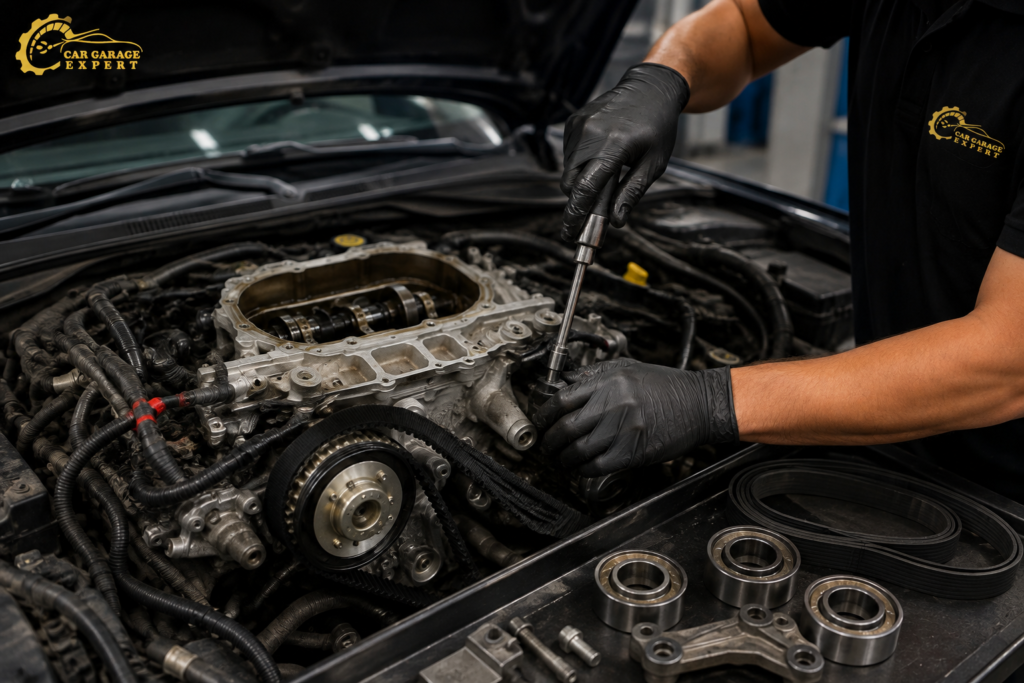
The first step was to inspect the Range Rover oil and coolant leak repair and investigate the customer’s reported symptoms.
Our technicians examined the vehicle for visible signs of coolant leakage and investigated the source of the unusual sound.
The inspection then moved toward the relevant mechanical components.
Because some components cannot be fully assessed from outside the vehicle, the relevant areas needed to be opened and inspected more closely.
This is where the importance of customer communication became particularly relevant.
Why Were Additional Parts Required?
Before the additional work was carried out, the customer was informed that if anything extra were discovered after opening the vehicle, the team would communicate it again.
Following the inspection, our staff identified additional parts needed to resolve the related issues completely.
The parts identified were:
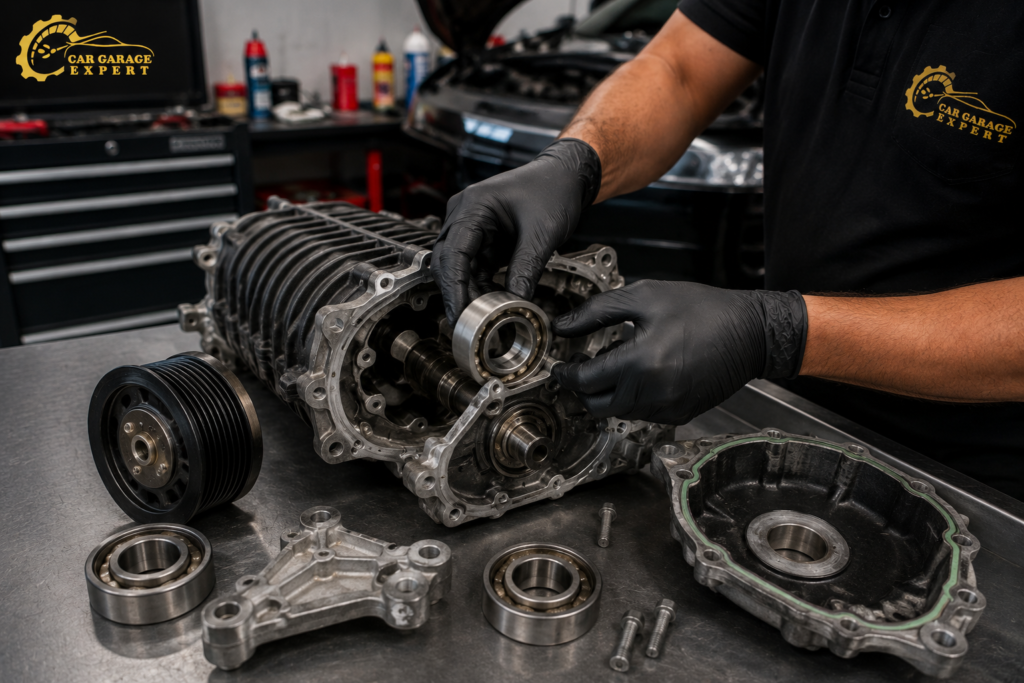
1. Supercharger Bearings
The supercharger uses bearings to support spinning parts and help them spin smoothly.
When bearings fail, they can make weird mechanical noises and vibrations. Installing new, clean bearings helps restore proper support for the affected spinning parts.
2. Fan Clutch Bracket
The fan clutch bracket forms part of the fan-support and accessory system.
A damaged or compromised bracket can contribute to movement, vibration, or abnormal mechanical noise. Its condition therefore needed to be addressed during the repair.
3. Supercharger Torsion Spring Coupler Isolator
The supercharger torsion spring coupler isolator is intended to assist in control of movement and mechanical forces within the supercharger drive arrangement.
Such a part might cause anomalous noise or vibration if it gets worn or broken.
4. Drive Belt
The drive belt transfers rotational power to various engine accessories.
A worn, damaged, or deteriorated belt can produce noises and should be inspected whenever related components are being repaired.
Because these components were found during the inspection, replacing them was recommended as part of completing the required repair rather than leaving potentially worn components in the system.
Repair Process For Range Rover Oil and Coolant Leak Repair
Once the additional requirements had been identified and communicated, the repair process could proceed.
Step 1: Initial Vehicle Assessment
The Range Rover was inspected based on the customer’s reported sound and coolant leak.
Step 2: Locate the Fluid Leak
The cooling system and surrounding areas were inspected to identify signs of coolant leakage and determine where further investigation was required.
Step 3: Investigate the Unusual Sound
The technicians examined relevant mechanical and accessory-drive components to identify potential sources of the reported sound.
Step 4: Open and Inspect Relevant Components
The affected area was opened so components that could not be accurately assessed externally could be examined.
Step 5: Identify Additional Worn Components
The inspection identified the two supercharger bearings, fan clutch bracket, torsion spring coupler isolator, and drive belt as parts requiring replacement.
Step 6: Communicate With the Customer
The customer was informed about the additional parts before the extra work was undertaken.
Step 7: Replace the Required Components
The identified components were replaced as part of the repair process.
Step 8: Reassemble and Inspect
After the required repairs, the relevant components were reassembled, and the vehicle was inspected.
Step 9: Final Checks
The vehicle should then be checked for remaining signs of leakage, abnormal noise, and other related symptoms before being returned to the customer.
Why Replacing Only One Part May Not Be Enough
A common mistake with complex vehicle repairs is to focus on the first failed component and ignore related parts.
For example, if a technician finds a worn bearing but also identifies a deteriorated belt and damaged bracket, replacing only the bearing may leave other potential sources of noise or mechanical problems unresolved.
That is why our approach at Car Garage Expert focuses on inspecting related components whenever the vehicle is already opened for repair.
The objective is not simply to replace a single part. It is to understand the complete condition of the affected system and recommend the work required to address the identified problems.
What Could Happen If a Coolant Leak Is Ignored?
A coolant leak should never be treated as a minor issue.
If coolant continues to escape, the cooling system may eventually have insufficient coolant to maintain the engine’s operating temperature.
Possible consequences of driving with a significant coolant leak include:
- Rising engine temperature
- Overheating
- Reduced engine performance
- Cooling-system damage
- Potential engine damage
- Vehicle breakdown
If the temperature gauge rises abnormally or a coolant warning appears, the vehicle should be stopped safely and inspected rather than continuing to drive.
Warning Signs Range Rover Owners Should Watch For
Range Rover owners should pay attention to changes in vehicle behavior.
Unusual Mechanical Noise
Grinding, whining, rattling, squealing, or other unfamiliar sounds should be investigated.
Coolant Under the Vehicle
Puddles or visible fluid around the engine bay can indicate a leak.
Falling Coolant Level
Repeatedly adding coolant is not a permanent solution. The system should be inspected to determine why the level is falling.
Engine Temperature Increasing
An increasing temperature gauge can indicate a cooling-system problem.
Belt Noise
Squealing or unusual belt-related sounds may indicate belt wear or problems with associated components.
Vibration
Unexpected vibration can sometimes indicate problems with rotating or supporting components.
Preventive Tips to Avoid Range Rover Cooling and Mechanical Problems
Regular maintenance can help identify developing problems before they become major repairs.
1. Check Coolant Levels Regularly
Monitor the coolant level according to the manufacturer’s recommendations. A repeatedly dropping level should be investigated.
2. Never Ignore a Coolant Leak
A leak may become worse over time. Early inspection can help prevent overheating.
3. Pay Attention to New Sounds
A new mechanical sound is often an early warning sign. Have it diagnosed before the affected component deteriorates further.
4. Inspect Drive Belts
Belts should be checked for cracks, deterioration, fraying, or other visible damage during scheduled maintenance.
5. Inspect Related Components
When repairing one component, technicians should inspect related parts that may also have experienced wear.
6. Follow the Correct Maintenance Schedule
Range Rover vehicles contain complex mechanical systems that benefit from regular professional inspection and maintenance.
7. Avoid Driving an Overheating Vehicle
If the engine temperature rises significantly, continuing to drive can turn a manageable cooling-system problem into a major engine repair.
What This Range Rover Oil and Coolant Leak Repair Case Teaches Us
This case started with a relatively straightforward customer complaint: an unusual sound and coolant leak.
However, once the vehicle was inspected and the relevant components were opened, additional parts were identified.
The two supercharger bearings, fan clutch bracket, supercharger torsion spring coupler isolator, and drive belt all required attention as part of the recommended repair.
The case highlights an important principle in automotive repair: the first symptom is not always the complete problem.
With a correct diagnosis , experts can dig into the system to see what else is related to it that may need to be addressed .
Why Choose Car Garage Expert for Range Rover Repair in Dubai?
Range Rover vehicles require careful diagnosis because their mechanical systems are complex and interconnected.
Car Garage Expert specialises in accurate inspection, straightforward communication, and working on the components highlighted in the diagnosis.
If a vehicle is opened and extra parts are found, customers should be advised prior to further work being carried out. This keeps it transparent and allows the car owner to see why additional repairs have been advised.
For Range Rover owners experiencing coolant leaks, unusual sounds, belt noise, or other mechanical concerns, professional inspection can help prevent a developing issue from becoming a larger problem.
Final Outcome
The Range Rover was inspected following the customer’s complaint of sound and coolant leakage.
During the inspection and opening of the relevant components, additional mechanical components were identified for replacement:
- 2 supercharger bearings
- Fan clutch bracket
- Supercharger torsion spring coupler isolator
- Drive belt
The customer was informed about these additional requirements so the necessary repair work could be carried out with a clear understanding of the parts involved.
This case shows the need to look at the associated components and not merely the primary symptom.
Conclusion
A coolant leak accompanied by an unusual sound should never be ignored, particularly in a complex luxury SUV such as a Range Rover.
The right approach is to identify the source of the leak, investigate the reported noise, inspect related components, and communicate any additional repair requirements before proceeding.
This Range Rover case also demonstrates why opening and inspecting the relevant components can reveal issues that are not immediately visible during an initial external inspection.
If your Range Rover is experiencing a coolant leak, unusual sound, belt noise, vibration, or other mechanical symptoms, arranging a professional inspection can help identify the problem before it develops into a more expensive repair.
Contact Car Garage Expert for Range Rover oil and coolant leak repair and get your Luxury road ready.