
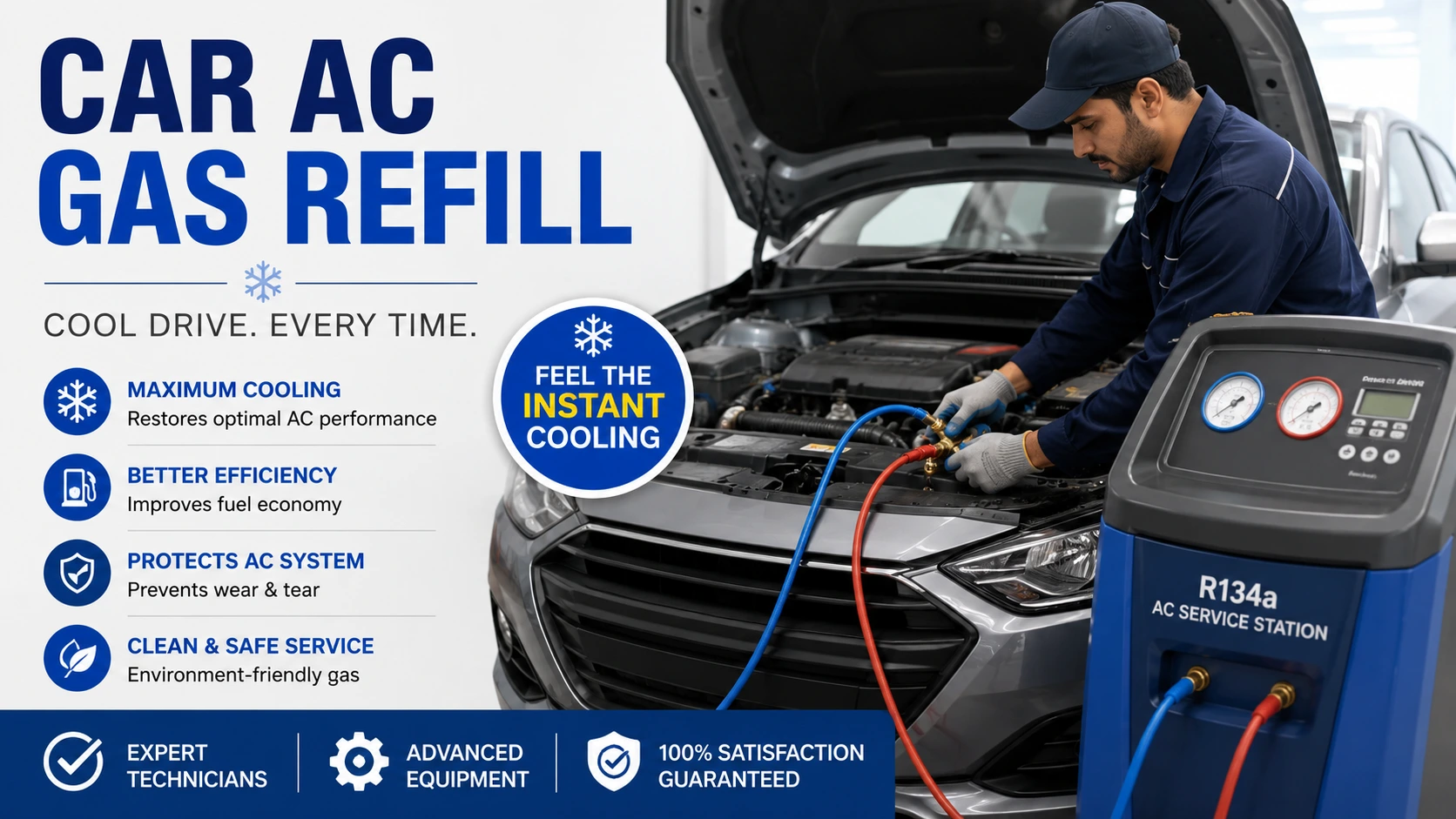
Most Dubai drivers know their car’s AC isn’t cooling as well as it used to — but fewer understand specifically why car AC gas levels affect both the cooling performance and the fuel consumption of the vehicle simultaneously.
The relationship between refrigerant charge, cooling output, and engine load is direct and measurable. A system with the correct car AC gas charge cools efficiently with the minimum compressor work. A system that’s low on refrigerant produces less cooling while demanding the same or greater engine effort — meaning worse performance, more fuel consumption, and progressively more compressor stress.
Understanding this relationship helps Dubai drivers make better decisions about when to act on AC concerns and what proper service actually involves.
Car AC Gas and Cooling Performance — The Direct Relationship
The refrigerant circuit in a car AC system carries heat from inside the cabin to outside the vehicle. Car AC gas — refrigerant — is the medium that does this work. It absorbs heat at the evaporator inside the dashboard, carries that heat through the circuit to the condenser at the front of the car, and rejects it to the outside air.
The efficiency of this heat transfer depends directly on the refrigerant charge being correct. Too little refrigerant and the system can’t move enough heat per cycle to cool the cabin adequately. The evaporator temperature rises, the air passing through it isn’t cooled as effectively, and the driver notices reduced cooling performance.
Dubai’s ambient temperatures make this relationship more consequential than in cooler markets. When outside temperatures reach 43°C, the AC system needs to move a large quantity of heat to maintain a comfortable cabin temperature. A correctly charged system manages this. A system low on car AC gas struggles — the cooling performance gap widens as ambient temperature increases, which is why owners often notice AC problems most acutely during the afternoon heat peak rather than in the morning.
How Car AC Gas Level Affects Each Component
The refrigerant charge affects every component in the AC circuit — not just the cooling output at the vents.
The Compressor Under Low Refrigerant Conditions
The AC compressor circulates refrigerant through the system and maintains the pressure differential that drives the heat transfer process. The compressor also circulates the compressor oil that lubricates its internal bearings — this oil travels through the system mixed with the car AC gas refrigerant.
When the refrigerant level drops from a leak, the oil concentration in the remaining refrigerant increases — but the total oil available to return to the compressor per cycle decreases. The compressor is running with less lubrication than its design assumes.
Sustained operation with low refrigerant accelerates compressor bearing wear. A system that’s been run low on car AC gas for an extended period often presents with compressor noise or failure alongside the low refrigerant — the two problems developing together rather than independently.
Compressor Pressure Protection
Most modern AC systems have a low-pressure protection switch that disables the compressor when refrigerant pressure drops below a specific threshold. This protects the compressor from running completely dry — but it doesn’t protect against the gradual bearing wear that accumulates from extended operation at marginally low refrigerant levels.
A driver who notices the AC cuts out intermittently — the compressor disengaging and re-engaging in rapid cycles — is seeing the low-pressure protection switch operating. The system is below its minimum charge threshold. This is a clear indicator that car AC gas level needs professional assessment.
The Condenser Under Incorrect Charge Conditions
The condenser rejects heat from the refrigerant to the outside air. Correct high-side pressure is required for the condenser to achieve efficient heat rejection — the refrigerant must reach the condenser at the correct pressure and temperature for the condensation process to complete correctly before the refrigerant reaches the expansion valve.
An overcharged system — too much car AC gas — raises high-side pressure above the design range. The condenser can’t reject heat fast enough at excessive pressure, the refrigerant temperature remains elevated, and the system efficiency drops. Overcharging also increases the risk of liquid refrigerant reaching the compressor inlet — a condition called slugging that causes immediate compressor damage.
Both undercharging and overcharging reduce system efficiency. Correct charge to the manufacturer’s specified weight — measured in grams on a calibrated scale — is the only condition where the system operates at design efficiency.
The Evaporator and Cabin Temperature
The evaporator’s job is to absorb heat from the cabin air as refrigerant evaporates through it. The temperature of the evaporator surface determines how effectively this heat absorption occurs — and evaporator temperature is directly controlled by the refrigerant pressure and flow rate through the expansion valve.
With correct car AC gas charge, the evaporator reaches the design temperature — typically 0–5°C at the surface — and cabin air passing through it is cooled effectively. With low refrigerant charge, evaporator pressure and temperature rise. The surface temperature increases. Cabin air passes through a less cold evaporator and is cooled less effectively.
The driver experiences this as warmer air from the vents — not completely warm air, but air that feels less cold than it should be. This is the earliest perceptible symptom of low car AC gas, and it typically appears first during the hottest part of the day when the system’s cooling demand is highest.
How Car AC Gas Affects Fuel Consumption
The relationship between car AC gas level and fuel consumption is less immediately obvious than the cooling performance impact — but it’s measurable and practically significant for Dubai drivers who use AC virtually continuously.
Compressor Load and Engine Output
The AC compressor is driven by the engine through a belt and clutch system. Every time the compressor is engaged, it draws power from the engine — increasing engine load and fuel consumption. Modern vehicles typically show 0.5–1.0 litres per 100km additional fuel consumption with AC operating, depending on ambient conditions and system load.
The amount of power the compressor requires depends on the pressure differential it must maintain — higher pressure differential requires more power. A correctly charged AC system maintains the design pressure differential efficiently. An incorrectly charged system — particularly an overcharged one — creates elevated high-side pressure that requires more compressor work and therefore more engine power to maintain.
Variable Displacement Compressor Efficiency
Most modern AC systems use variable displacement compressors rather than fixed-stroke units. A variable displacement compressor adjusts its output based on cooling demand — reducing displacement under light cooling load and increasing it when maximum cooling is needed.
The efficiency advantage of a variable displacement compressor depends on the refrigerant circuit being correctly charged and all components functioning correctly. A system with incorrect car AC gas charge forces the variable displacement compressor to operate at non-optimal displacement settings as it attempts to compensate for the pressure anomalies created by incorrect charge. This increases fuel consumption beyond what the same ambient conditions would produce with a correctly charged system.
The Long-Term Fuel Consumption Impact
In Dubai, where AC operates for nine to ten months of the year with significant intensity for five to six months, the fuel consumption impact of a marginally low car AC gas system accumulates meaningfully over a full year of ownership.
A system running at 85% of correct charge doesn’t produce 85% of normal cooling — it produces less than that because of the cascading inefficiencies through the circuit. And it consumes proportionally more fuel per unit of cooling delivered because the compressor is working harder for reduced output.
Signs That Car AC Gas Level Is Affecting Your Vehicle
Recognising the specific symptoms of incorrect car AC gas charge helps Dubai drivers identify the problem and act on it before it develops into compressor damage.
Warm Air From Vents in Peak Heat
The most common symptom is AC that works adequately in the morning but struggles to maintain comfortable cabin temperature during afternoon peak heat. A system correctly charged at a lower ambient temperature may show marginal cooling at 35°C morning conditions and inadequate cooling at 43°C afternoon conditions.
This temperature-dependent performance variation is the most diagnostic symptom of low car AC gas — it directly reflects the reduced thermal capacity of a marginally undercharged system being overwhelmed by higher ambient heat load.
Compressor Cycling Rapidly
A compressor that engages and disengages in short rapid cycles — rather than holding continuous engagement — is operating near or below the low-pressure cut-out threshold. Each engagement cycle is followed by rapid pressure drop as the marginal refrigerant charge is quickly circulated and pressure falls again.
This symptom indicates the system needs car AC gas assessment urgently — the rapid cycling is stressing the compressor clutch and the compressor itself with repeated start-stop cycles rather than sustained smooth operation.
Increased Fuel Consumption Alongside Reduced Cooling
The combination of reduced cooling performance and increased fuel consumption together is a strong indicator of AC system inefficiency — either from low car AC gas, a partially blocked condenser, or a failing expansion valve. The system is consuming more energy to produce less cooling — exactly the signature of these specific faults.
If fuel consumption has increased noticeably over the period where AC performance has also declined, the AC system is the likely common cause.
Ice Formation on the Suction Line
Paradoxically, a system significantly low on car AC gas can develop ice on the suction line — the low-pressure line running from the evaporator back to the compressor. When refrigerant pressure is very low, evaporator temperature drops below design range as the remaining refrigerant expands more than intended. Moisture in the ambient air freezes on the cold suction line surfaces.
Ice on the AC suction line while the vents produce reduced cooling indicates a system significantly undercharged or with a failing expansion valve — either way, an immediate car AC gas assessment is appropriate.
R134a vs R1234yf — Why the Refrigerant Type Matters
Not all car AC gas is the same, and using the wrong refrigerant type is one of the most consequential mistakes made in improper AC service.
R134a — The Established Refrigerant
R134a has been the standard automotive refrigerant for decades and remains the correct car AC gas for the majority of vehicles in Dubai’s market. Its pressure-temperature characteristics, thermodynamic properties, and compatibility with standard AC system components and seal materials are well-established.
R134a is handled with standard AC service equipment and is widely available across Dubai’s workshop market.
R1234yf — The Newer Low-GWP Refrigerant
R1234yf is mandated for new vehicles in European and American markets to meet environmental requirements. It appears increasingly in newer vehicles in Dubai’s market as global vehicle production standardises on the newer refrigerant.
R1234yf has different pressure-temperature characteristics from R134a, requires different handling equipment, and is significantly more expensive per kilogram. A system designed for R1234yf cannot be correctly serviced with R134a — the thermodynamic mismatch prevents correct system operation and the different seal compatibility means R134a can damage seals designed for R1234yf.
A proper car AC gas service confirms the refrigerant type from the vehicle’s service label before any refrigerant is added. A workshop that defaults to R134a for every vehicle is using the wrong refrigerant on any newer R1234yf system in the workshop — and creating a problem that requires complete system purge and correct recharge to correct.
What Proper Car AC Gas Service Includes
A complete car AC gas service follows a specific sequence. Any workshop skipping steps in this sequence is providing an incomplete service.
Leak Detection Before Recharging
A correctly functioning AC system doesn’t consume refrigerant. If the system is low on car AC gas, refrigerant has leaked out through a specific failure point. Adding refrigerant without finding and repairing the leak means the refrigerant escapes at the same rate as before — the owner is back in the same situation within weeks.
UV dye leak detection makes invisible refrigerant leaks visible under UV light — the dye fluoresces at the leak location, identifying whether the source is a condenser pinhole, an O-ring connection, an evaporator leak, or a compressor shaft seal failure.
Vacuum Evacuation
Before any refrigerant is added, the system is evacuated to vacuum using an AC vacuum pump. This removes any air that entered the system through the leak path, and removes moisture that would form hydrofluoric acid in the refrigerant circuit.
A minimum 30-minute vacuum hold confirms the system holds vacuum before recharging begins. A system that doesn’t hold vacuum has a leak requiring repair before car AC gas is added.
Correct Refrigerant Weight
Refrigerant must be added by weight — grams measured on a calibrated digital scale — to the manufacturer’s specified charge. The specification is on a label in the engine bay. Adding refrigerant until the pressure gauges “look right” is an approximation that can produce both undercharge and overcharge depending on ambient temperature during the service.
Post-Service Performance Verification
After correct car AC gas charge is confirmed, vent temperature measurement and operating pressure on both high and low sides verify the system is producing correct cooling performance. For owners seeking comprehensive vehicle care, a proper car service alongside the AC service addresses both the cooling system and the mechanical condition of the vehicle. A qualified car mechanic with correct AC diagnostic equipment handles the full service correctly. For owners needing initial on-site assessment, a mobile car mechanic performs basic AC pressure checks at the vehicle’s location. Proper roadside assistance ensures the vehicle reaches the workshop safely when an AC failure coincides with another concern. For owners in Al Quoz looking for a garage near me that services car AC gas correctly — leak detection first, correct refrigerant type, weight-measured recharge, and performance verification — the difference from a workshop that simply adds gas until the pressure looks acceptable shows immediately in how long the cooling lasts.
FAQ
How do I know if my car AC gas is low in Dubai?
Reduced cooling that's worse in afternoon peak heat, compressor clutch cycling rapidly, or AC that works in the morning but struggles when ambient temperature exceeds 40°C are the clearest indicators.
Does low car AC gas increase fuel consumption?
Yes — a system low on refrigerant forces the compressor to work harder for reduced cooling output, increasing engine load and fuel consumption simultaneously.
How often does car AC gas need refilling in Dubai?
A correctly functioning system shouldn't need regular refilling — if it does, a leak exists that should be found and repaired before any refrigerant is added.
What is the difference between R134a and R1234yf car AC gas?
They are incompatible refrigerants with different pressure characteristics, requiring different equipment and different pricing — the correct type for the specific vehicle must be confirmed before any service.
Can overcharging the AC gas cause damage?
Yes — excessive refrigerant raises high-side pressure above design range, reduces efficiency, and risks liquid refrigerant entering the compressor inlet, causing immediate internal damage.
Conclusion
Car AC gas charge directly determines both cooling performance and fuel consumption in Dubai’s demanding climate. A correctly charged system cools efficiently with minimum compressor work. A system running low on refrigerant produces less cooling while consuming more fuel and progressively wearing the compressor. Understanding this relationship — and ensuring any AC service starts with leak detection rather than refrigerant addition — is what separates a repair that lasts from one that returns the same problem within weeks.
Car Garage Expert in Al Quoz handles car AC gas services with leak detection, correct refrigerant type confirmation, weight-measured recharge, and post-service performance verification for all makes. Book your appointment on WhatsApp or find the workshop on Google Maps.