
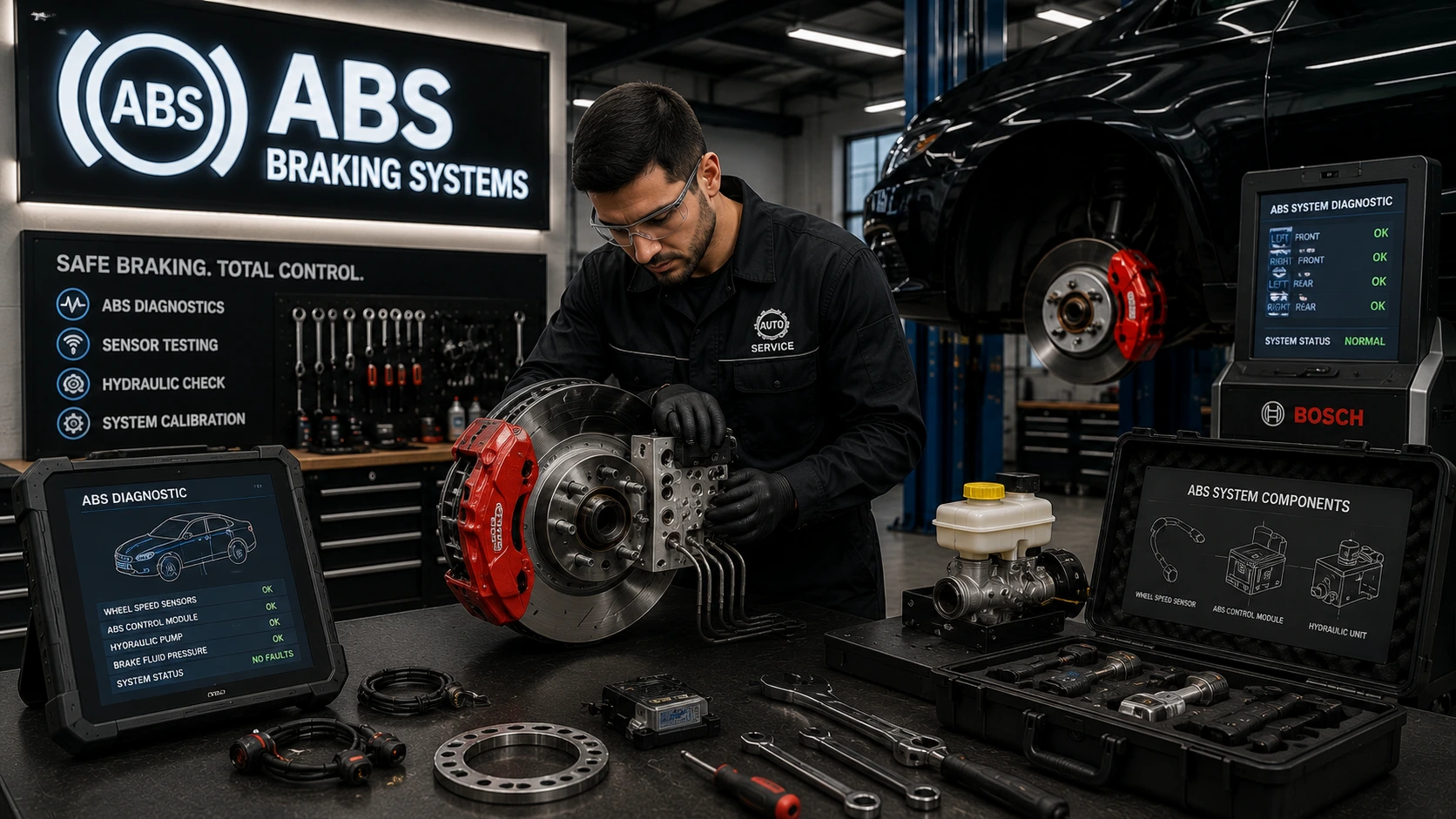
The ABS warning light is one of the most commonly dismissed dashboard warnings in Dubai. Drivers see it appear, notice that the car still stops normally, and decide it can wait until the next service. Sometimes it does wait. Sometimes it doesn’t — and the moment it matters is exactly the situation where a functioning ABS braking system is the difference between a controlled emergency stop and a locked-wheel skid.
ABS braking systems — Anti-lock Braking Systems — prevent wheel lockup during hard braking by modulating brake pressure at each wheel independently. This allows the driver to maintain steering control during emergency stops, which is the capability that separates a car that can avoid a collision from one that goes straight regardless of steering input.
Understanding the warning signs, what causes them, and what proper diagnosis looks like helps Dubai drivers make informed decisions rather than dismissed ones.
ABS Braking Systems Dubai — Why These Faults Need Proper Attention
Dubai’s motorway network creates specific scenarios where ABS braking systems matter more than in urban-only driving. Hard braking from 120 km/h on Sheikh Zayed Road. Emergency stops when merging traffic creates sudden deceleration demands. Wet road surfaces during Dubai’s sporadic but intense rain events — where tyre hydroplaning creates exactly the loss-of-traction conditions ABS was designed to manage.
A disabled ABS system doesn’t affect normal braking. The hydraulic brake system functions the same whether ABS is operational or not — and this is precisely why many drivers don’t treat an ABS warning with urgency. The car stops fine. Until it doesn’t — until a hard emergency stop from speed on a wet road produces wheel lockup, the tyres lose grip, and the car goes straight regardless of what the driver does with the steering wheel.
A Mercedes C200 came to Car Garage Expert after the owner had been driving with an ABS warning light for three months. On a routine inspection, our diagnostic found a rear left wheel speed sensor with a completely failed signal — the ABS system had disabled itself entirely rather than operate on incomplete wheel speed data. Two weeks later the owner described an incident on Emirates Road during rain where the brakes felt “different” under hard application. The ABS was not functioning. The car had no anti-lock capability in the emergency stop that followed.
The warning light is the system telling you it has disabled itself. That’s the message to act on.
How ABS Braking Systems Work — The Foundation of Diagnosis
Understanding the basic architecture of ABS braking systems makes the diagnostic process more comprehensible — and makes the most common fault patterns immediately recognisable.
The Four-Sensor Architecture
Most modern vehicles use a four-sensor ABS architecture — one wheel speed sensor at each corner. Each sensor reads a toothed reluctor ring (tone ring) attached to the wheel hub or axle shaft, generating an electrical signal proportional to wheel rotation speed.
The ABS control unit — called the ABS ECU or HECU (Hydraulic Electronic Control Unit) — monitors all four sensors simultaneously. During normal braking, it observes each wheel decelerating at the expected rate. During hard braking, if one wheel begins decelerating faster than the others — indicating impending lockup — the HECU modulates the brake pressure to that wheel by cycling the relevant solenoid valves in the ABS hydraulic unit. This allows the wheel to spin up slightly, restore grip, and decelerate again — the cycle repeating many times per second.
The driver feels this as the characteristic pulsation of ABS activation — a pedal vibration that indicates the system is working.
When the System Disables Itself
The ABS ECU performs self-diagnostics continuously. When a fault is detected — a sensor signal dropout, a sensor reading outside expected parameters, a hydraulic solenoid that isn’t responding correctly, or a control unit fault — the system logs the fault, illuminates the ABS warning light, and disables the anti-lock function.
The base hydraulic brakes continue operating normally. The ABS modulation capability is removed. The system chooses this because operating ABS on incorrect data could be more dangerous than not operating it at all — a scenario where the system incorrectly identifies a wheel as locking up and releases brake pressure when it shouldn’t.
Warning Signs of ABS Braking System Problems
Recognising what an ABS braking system fault looks like — and what it doesn’t look like — helps owners distinguish genuine faults from normal operation and intermittent faults from permanent ones.
ABS Warning Light — The Primary Indicator
The ABS warning light is the direct indication that the system has detected a fault and disabled itself. It should illuminate briefly when the ignition is first switched on — a self-test routine — and then extinguish within a few seconds. A light that stays on indicates a stored fault.
Intermittent ABS Warning Light
An ABS light that appears at certain speeds and disappears at others, or that illuminates during a cold start and clears once the car has warmed up, indicates a sensor signal that’s marginal rather than completely failed.
This pattern is common with wheel speed sensors in Dubai from two specific causes: bearing wear that has increased the sensor-to-reluctor ring gap beyond the sensor’s reliable reading range, and connector corrosion that creates intermittent signal dropout under thermal expansion and contraction.
Both are developing faults that become permanent failures without intervention. An intermittent ABS braking system warning warrants diagnosis — not monitoring.
ABS and Stability Control Warning Together
ABS and ESC/DSC warning lights appearing simultaneously indicates a fault that affects both systems — because electronic stability control relies on wheel speed sensor data from the ABS system to function.
A single failed wheel speed sensor disables both ABS and stability control simultaneously. Multiple warning lights from a single fault is one of the most informative patterns in ABS braking systems diagnosis — it points directly to the shared input that both systems rely on.
Pulsating Brake Pedal During Normal Braking
ABS activation produces a characteristic brake pedal pulsation — this is normal and expected during hard braking on a low-grip surface. The pulsation indicates the system is working correctly.
A pulsating brake pedal during normal, moderate braking on a dry road is not normal ABS operation. This indicates one of two conditions.
Warped Brake Disc
The most common cause of pulsation during normal braking in Dubai is a warped brake disc. As the disc rotates, its uneven thickness variation alternately contacts and releases the brake pad, producing the pulsation felt through the pedal. This is a mechanical brake fault, not an ABS braking system fault — though drivers sometimes confuse the two.
False ABS Activation
An ABS sensor reading incorrectly — from damage, contamination, or a bearing fault that creates speed signal irregularity — can produce false ABS activation during normal braking. The HECU interprets the irregular sensor signal as wheel lockup and releases brake pressure momentarily, producing the pedal pulsation characteristic of ABS operation on a road surface where it shouldn’t be activating.
This is a genuine ABS braking system fault that requires diagnosis and repair — and it’s more dangerous than a simple warning light, because the false activation reduces actual braking performance during normal stops.
Increased Stopping Distance
A subtle increase in stopping distance — particularly noticeable when comparing braking feel over time — can indicate ABS braking system involvement even without an active warning light.
A sensor that’s producing a marginally incorrect signal doesn’t always trigger the fault threshold that illuminates the warning light. But the HECU may be making suboptimal decisions based on slightly incorrect data — activating ABS slightly too early, or on a wheel that isn’t actually close to lockup.
Brake stopping distance assessment as part of a proper ABS braking systems check at a quality car service visit catches these marginal cases before they become more obvious faults.
Grinding or Unusual Noise During Braking
A grinding noise specifically during braking — not during general driving — usually indicates a brake pad, disc, or caliper concern rather than an ABS fault. However, certain ABS braking system faults can produce noise.
A reluctor ring that has developed damage — cracking, corrosion, or physical tooth damage from road debris impact — creates irregular sensor signals alongside a noise during wheel rotation. The ring is typically integral to the wheel hub bearing assembly, and damage to it requires hub or bearing replacement.
Noise during braking should always be investigated — distinguishing between a pure mechanical brake fault and an ABS braking system component concern requires a ramp inspection and diagnostic scan.
What Causes ABS Braking System Faults in Dubai
Dubai’s specific operating environment creates ABS fault patterns that differ from what European service manuals prioritise.
Wheel Speed Sensor Failures
Wheel speed sensors are the highest-volume ABS braking system repair item in Dubai’s market. Several causes contribute.
Connector Corrosion
Dubai’s humidity cycling — between air-conditioned garage environments and 45°C exterior temperatures — creates condensation at electrical connector interfaces. The ABS wheel speed sensor connectors, located near each wheel in the undercarriage, are exposed to this cycling continuously. Over time, corrosion develops at the connector contacts, creating high resistance that appears as intermittent signal dropout to the HECU.
Connector cleaning and appropriate corrosion protection resolves many sensor “failures” that would otherwise result in sensor replacement.
Gap Increase from Bearing Wear
The wheel speed sensor reads the reluctor ring through a precise gap. As the wheel bearing wears, the play that develops allows the hub to move slightly — increasing the effective gap between sensor and reluctor ring, reducing signal strength, and eventually causing signal dropout.
A ABS braking systems diagnostic that finds a wheel speed sensor fault should always include bearing play assessment on the affected corner. Replacing the sensor without addressing the bearing play means the new sensor fails at the same rate as the old one — because the root cause hasn’t been addressed.
Road Debris Physical Damage
Speed bumps hit at inappropriate speeds throw debris from road surfaces with enough force to damage ABS sensor bodies and wiring harnesses in the underbody area. Physical sensor damage produces a permanent, non-intermittent fault — the sensor’s output is either zero or incorrect regardless of conditions.
ABS Pump and Hydraulic Unit Faults
The ABS hydraulic unit — containing the solenoid valves and the recirculation pump — can develop electrical faults in the solenoid coils and mechanical faults in the pump motor.
Solenoid faults typically produce ABS warning lights without affecting brake feel during normal driving. Pump motor faults may produce a noise from the hydraulic unit during ABS activation — or complete absence of the normal ABS pulsation during emergency braking.
A ABS braking systems diagnostic that finds a hydraulic unit fault requires ODIS, XENTRY, ISTA, or equivalent manufacturer-compatible diagnostic access to test individual solenoid activation and hydraulic pressure response. Generic scanners read the fault code but can’t perform the actuator testing that confirms the fault is in the solenoid rather than its wiring circuit.
ABS Control Unit Software Faults
The ABS ECU can develop software faults that produce warning lights without any sensor or hydraulic fault being present. These are typically resolvable through software update via the manufacturer-compatible diagnostic system.
A software fault that produces an ABS braking systems warning but shows no sensor or solenoid fault in the diagnostic scan — with all sensors reading correctly in live data — is the classic indicator of a software issue rather than hardware failure.
Proper ABS Braking System Diagnosis — What It Should Cover
A genuine ABS braking systems diagnosis at a quality workshop covers every element of the system, not just reading the fault code and replacing the sensor it names.
Full Fault Code Scan — All Systems
ABS fault codes don’t exist in isolation. A full system scan — covering ABS, ESC, engine management, and body control — identifies whether the ABS fault is primary or whether it’s a consequence of another system fault. A tyre pressure sensor fault producing incorrect wheel speed correlation can trigger an ABS warning as a secondary consequence.
Live Data Wheel Speed Assessment
All four wheel speed sensors should be assessed in live data during a slow test drive. A sensor reading correctly at rest may show signal dropout, signal noise, or incorrect speed correlation during wheel rotation — only visible in live data during movement.
Comparing all four sensors simultaneously in live data — confirming that each reads the same speed when the car is travelling straight at a known speed — identifies sensors that are within threshold but producing inferior signals compared to the others.
Bearing Play Assessment
Ramp inspection of each corner for bearing play — grasping the tyre at 12 and 6 o’clock and applying force to detect hub movement. Play here indicates bearing wear that will continue degrading the ABS sensor signal even after sensor replacement.
Reluctor Ring Inspection
Visual inspection of the reluctor ring on each corner — looking for corrosion, damage, or missing teeth. The reluctor ring on vehicles with bearing-integrated tone rings requires bearing assessment when ring condition is compromised.
Hydraulic Unit Actuator Testing
For faults pointing to the hydraulic unit, solenoid and pump actuator testing via the manufacturer-compatible diagnostic system. This distinguishes between solenoid wiring faults and solenoid hardware faults — determining whether the repair is a wiring repair or a hydraulic unit replacement.
A qualified car mechanic with the correct diagnostic equipment performs this full assessment sequence rather than replacing the first component the fault code points to.
ABS Repair Costs in Dubai
Realistic figures for common ABS braking systems repair work at a quality independent in Al Quoz:
- Wheel speed sensor replacement — single corner Quality independent: AED 250–500 | Dealer: AED 500–950
- Wheel bearing replacement with integrated tone ring — single corner Quality independent: AED 600–1,200 | Dealer: AED 1,200–2,200
- ABS wiring harness repair — single circuit Quality independent: AED 300–600 | Dealer: AED 600–1,100
- ABS hydraulic unit replacement Quality independent: AED 2,500–5,000 | Dealer: AED 5,500–10,000
- ABS ECU replacement and coding Quality independent: AED 1,500–3,500 | Dealer: AED 3,500–7,000
- Full ABS diagnostic scan and assessment Quality independent: AED 180–300 | Dealer: AED 380–600
For owners needing immediate support when an ABS warning appears, a qualified mobile car mechanic can perform an initial fault code scan and assessment on-site — determining whether the fault is sensor-level and safe to address with a short workshop visit, or whether the system has a more significant fault requiring immediate assessment.
When an ABS fault coincides with a brake system concern that makes the vehicle unsafe to drive, proper roadside assistance ensures the car reaches the workshop without being driven on a compromised brake system.
For owners in Al Quoz and surrounding areas searching for a garage near me that diagnoses ABS braking systems properly — full sensor live data assessment, bearing check, and hydraulic unit testing rather than fault code reading and sensor replacement — the difference from a parts-substitution approach is measurable in both repair accuracy and total cost.
FAQ
Is it safe to drive with the ABS warning light on in Dubai?
The base brakes function normally, but the anti-lock capability is disabled — on wet roads or during emergency stops from motorway speed, this significantly increases the risk of wheel lockup and loss of steering control.
What is the most common ABS fault in Dubai?
Wheel speed sensor failure from connector corrosion or bearing wear that increases the sensor-to-reluctor gap — both accelerated by Dubai's humidity cycling and speed bump impacts.
Can an ABS warning light appear from a cause other than the ABS system?
Yes — a failing tyre pressure sensor, a voltage drop from a degraded battery, or a wiring fault in the ABS circuit can all trigger the ABS warning light without a failed ABS sensor or solenoid.
Why do my ABS and stability control lights come on together?
Electronic stability control uses the same wheel speed sensors as ABS — a single sensor fault typically disables both systems simultaneously, producing both warning lights.
How long does a proper ABS diagnosis take?
A complete assessment covering fault code scan, live data wheel speed testing, bearing play assessment, and ramp inspection typically takes 45–60 minutes.
Conclusion
ABS braking systems warnings are the car’s notification that it has disabled a safety capability. In Dubai’s motorway environment — where emergency stops from high speed are occasional realities and wet road events are sudden and intense — an ABS system that’s disabled is a genuine safety concern rather than a deferred maintenance item.
Car Garage Expert in Al Quoz handles ABS braking system diagnosis and repair across all makes — wheel speed sensor assessment, bearing inspection, hydraulic unit testing, and control unit diagnosis with manufacturer-compatible equipment. Book your appointment on WhatsApp or find the workshop on Google Maps.