Most Audi faults in the UAE don’t appear suddenly. They start as a faint rattle on a cold morning, a slightly hesitant gear change in traffic, or a check engine light that clears itself and comes back a week later. Knowing what these specific signs actually mean — rather than guessing or ignoring them — is what separates an owner who catches a problem at AED 600 from one who’s looking at a AED 15,000 gearbox repair. This guide for Audi Service and Repair UAE covers the faults that come through our Al Quoz workshop most often, and what genuinely causes each one.
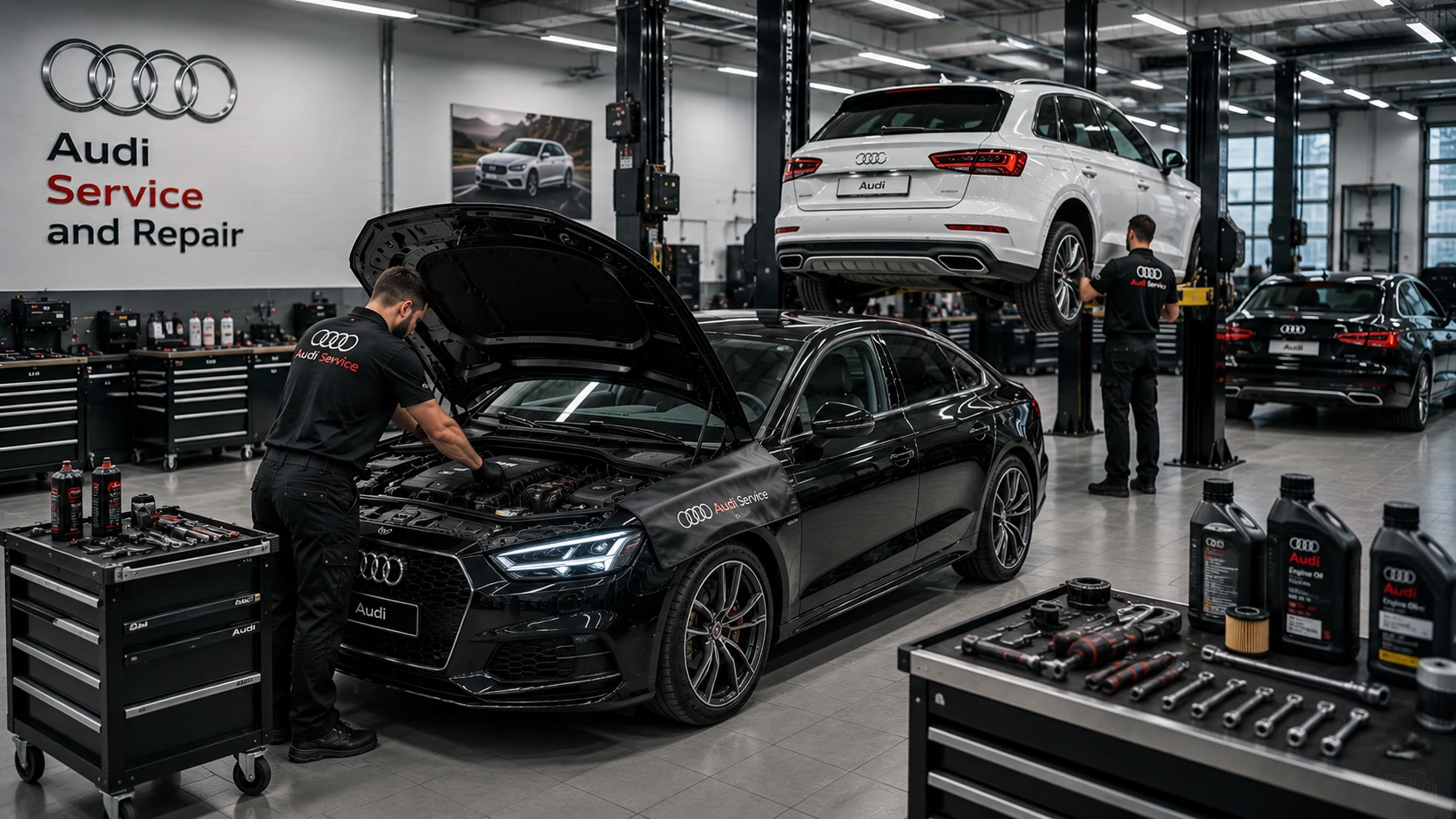
At Car Garage Expert in Al Quoz, every fault diagnosis starts with VCDS — the same factory-level diagnostic platform Audi’s own network uses — read alongside a physical inspection, not a guess based on the symptom alone.
Audi Service and Repair UAE — The Faults We See Most Often
Dubai’s heat, stop-start traffic, and short commute patterns accelerate specific Audi faults faster than the same vehicle would develop them in Europe. These three categories cover the overwhelming majority of what comes through our workshop.
Audi Service and Repair UAE Priority — Timing Chain Tensioner Wear on EA888 TFSI Engines
The Cold-Start Rattle That Means Something Specific
A metallic rattle from the front of the engine on cold starts, particularly noticeable on Audi A3, A4, and Q5 models with the 2.0 TFSI EA888 engine, points directly to a timing chain tensioner that’s losing hydraulic pressure overnight. The noise typically clears within 10–15 seconds as oil pressure builds and the tensioner takes up the slack — which is exactly why owners dismiss it as nothing. It isn’t nothing. It’s the chain stretching gradually with each cold start cycle.
Why Dubai Conditions Make This Worse
Repeated short trips — the school run, a quick errand, the daily commute split into multiple cold starts rather than one continuous drive — give the tensioner less opportunity to maintain consistent hydraulic pressure than a vehicle doing fewer, longer journeys. Each cold start with a degraded tensioner adds incremental chain stretch.
What Happens If It’s Ignored
This is one of the most overlooked priorities in Audi Service and Repair UAE work — if the chain slips even slightly on startup, the result on these direct-injection engines is immediate valve-to-piston contact — catastrophic, sudden engine damage rather than a gradual decline. We diagnose tensioner wear through VCDS live data and physical chain slack measurement before it reaches this point, then carry out tensioner replacement, guide inspection, and an oil system flush using correct long-life specification oil.
DSG Transmission Faults in Stop-Start Traffic
Shuddering and Hesitation From the DQ200 Dry-Clutch Unit
The DQ200 7-speed dry-clutch DSG, fitted across the A3, A4, and Q3 ranges, is particularly sensitive to Dubai’s repeated low-speed stop-start engagement. The symptom — a noticeable shudder pulling away from a stop, or hesitation before the gearbox engages — is the most frequent transmission complaint we handle in our Audi Service and Repair UAE workshop.
Why It’s Frequently Misdiagnosed as Clutch Wear
This is the distinction that matters most for cost. The shudder is commonly assumed to mean the clutch packs are worn and need replacing — a AED 8,000–15,000 repair. In a significant proportion of cases, the actual cause is degraded DSG fluid combined with drifted clutch adaptation values, not physical clutch wear. A VCDS-guided fluid exchange and clutch adaptation reset, standard practice in proper Audi Service and Repair UAE work, resolves it without touching the mechanical clutch components at all.
Why DSG Fluid Fails Faster in UAE Heat
Audi specifies DSG fluid service around 60,000 km under standard conditions. In Dubai’s sustained heat and stop-start traffic, this fluid commonly degrades by 40,000 km — roughly a third sooner than the factory interval assumes. The mechatronic unit overheats as fluid viscosity drops, which is what produces the shuddering and delayed engagement symptoms in the first place.
Carbon Buildup on Direct-Injection Intake Valves
Why Audi’s Direct Injection Creates This Problem
Audi’s direct-injection TFSI engines spray fuel straight into the combustion chamber rather than over the intake valves. That’s good for efficiency, but it removes the natural fuel-wash effect that keeps intake valves clean on older port-injection engines. Without that cleaning action, oil vapour from the crankcase ventilation system deposits carbon on the valve backs continuously.
The Symptoms That Point to This Specifically
Rough or uneven idle, hesitation under acceleration, and inconsistent throttle response are the classic signs — particularly on A4, A5, A6, and Q5 models running the common 2.0 TFSI variants. Dubai’s heat and stop-start traffic accelerate this buildup compared to longer, steadier European driving cycles.
The Correct Fix Versus the Shortcut
Fuel additives marketed as carbon cleaners don’t reach the intake valve backs in any meaningful way — the fuel never touches that surface in a direct-injection engine. The actual fix is removing the intake manifold and physically cleaning the valves through walnut shell blasting, a procedure that requires the right equipment and genuinely restores airflow rather than masking the symptom temporarily.
Our car mechanic team carries out walnut blasting as a standalone service when carbon buildup is confirmed through VCDS fuel trim data — not assumed from the symptom alone, which is the standard every Audi Service and Repair UAE diagnosis should meet.
Audi Service and Repair UAE — Electrical and Cooling Faults Worth Knowing
Beyond the engine and gearbox, two other categories account for a large share of the Audi Service and Repair UAE work we see — and both are commonly misdiagnosed without the right diagnostic platform.
The EPC Light and What It Actually Means
A Warning That Covers Multiple Systems
The EPC (Electronic Power Control) light indicates a fault somewhere in the throttle, brake, or engine sensor systems — but the light itself doesn’t tell you which one. Driving with it on can make the car noticeably harder to control and, depending on the underlying cause, risks further damage if ignored.
Why a Generic Scanner Often Gets This Wrong
A generic OBD2 reader sees an EPC-related code and stops there. VCDS reads the full module network — throttle position sensor data, brake pedal sensor signals, and engine management communication — and identifies which specific component triggered the fault rather than leaving you with a vague system-wide warning.
Cooling System Strain From Dubai Heat
Why Even Minor Cooling Faults Escalate Quickly Here
Dubai’s ambient temperatures put exceptional stress on Audi cooling systems compared to the conditions these vehicles were originally engineered around. A water pump or thermostat fault that would develop slowly in a temperate climate can progress to overheating within a much shorter window here, particularly in stop-start summer traffic.
What a Proper Cooling Check Actually Involves
A radiator pressure test and thorough component inspection — not just a coolant level check — is what catches a developing fault before it becomes an overheating event. We check coolant concentration with a refractometer and pressure-test the full circuit at every major service rather than relying on a visual assessment.
For any breakdown on the road, our roadside assistance covers Al Quoz and nearby Dubai areas. Our car service packages include cooling system inspection and VCDS scanning at every visit.
Why Audi Service and Repair UAE Needs VCDS Specifically
What VCDS Reads That Generic Tools Miss
VCDS (VAG-COM Diagnostic System) is the factory-level software Audi’s own network uses — reading manufacturer-specific fault codes across every module, performing adaptation resets after part replacement, and running live data during a road test. A workshop without it is working with a fraction of the information available.
How to Confirm a Workshop Actually Has It
Ask directly whether they use VCDS or an equivalent factory-level platform, by name — not a vague reference to “advanced diagnostics.” A workshop genuinely equipped for Audi Service and Repair UAE answers this immediately and specifically.
For exterior repairs alongside mechanical work, our car painting team handles colour-matched Audi repairs. For an on-site assessment before driving in, our mobile car mechanic covers Al Quoz and nearby Dubai areas.
Finding Audi Service and Repair UAE in Al Quoz
If any of these symptoms sound familiar, Car Garage Expert is a garage near me in Al Quoz accessible from Business Bay, Jumeirah, Barsha, Satwa, Downtown, and the Sheikh Zayed Road corridor.
Conclusion
Audi Service and Repair UAE done properly means recognising these faults at their earliest stage — the cold-start rattle, the DSG hesitation, the rough idle from carbon buildup — and diagnosing with the right tools before assuming the most expensive cause. That’s the standard at Car Garage Expert for every Audi that comes through Al Quoz.
Car Garage Expert is in Al Quoz, serving Audi owners across nearby Dubai areas — Business Bay, Jumeirah, Downtown, Barsha, Satwa, and the Sheikh Zayed Road corridor. Book your appointment on WhatsApp and find us on Google Maps.
Car Garage Expert — Audi Service and Repair UAE | Al Quoz, Dubai and Nearby Areas