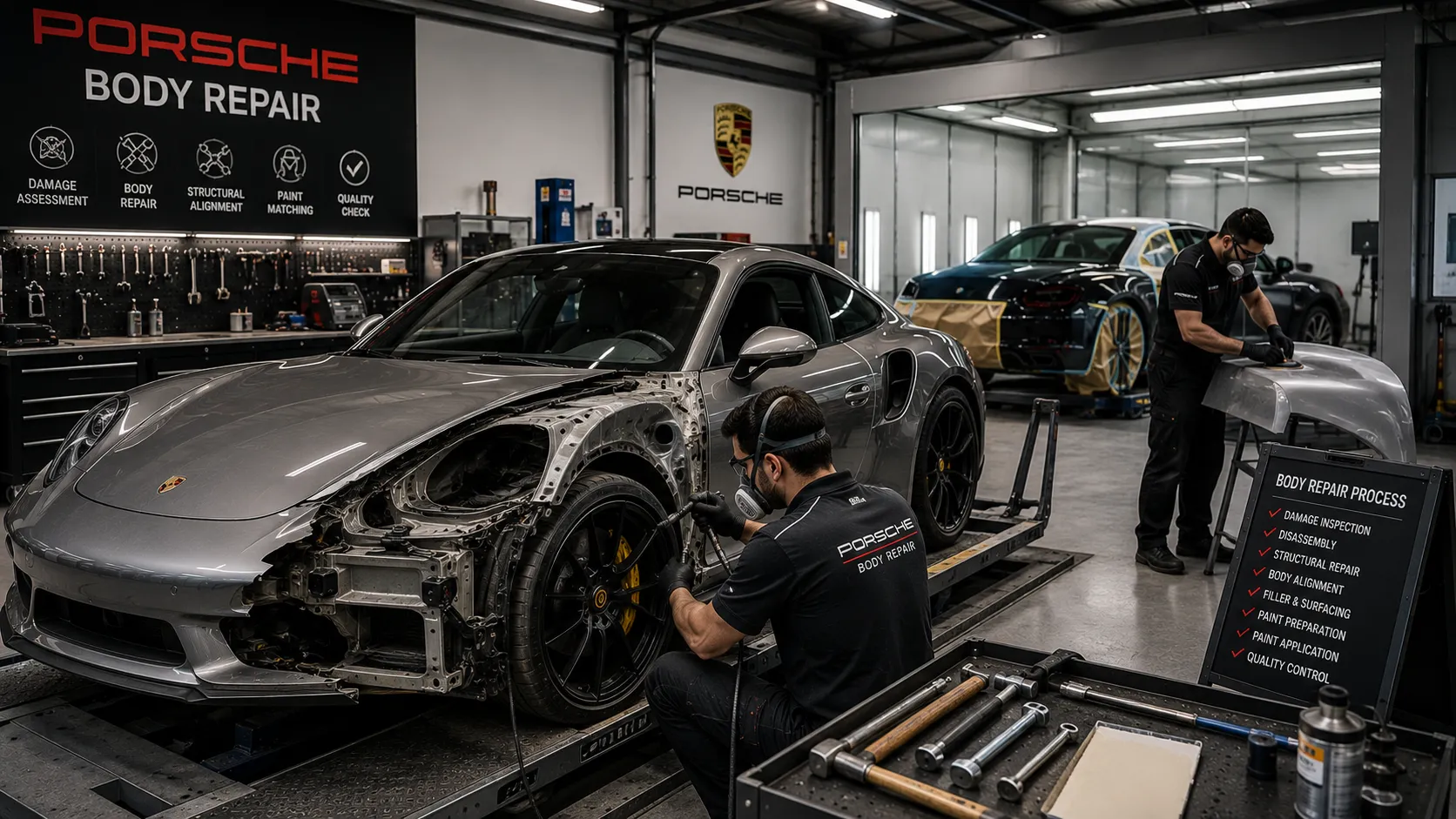
A Porsche is not just a car — it’s a precision-engineered machine where every panel gap, every paint layer, and every structural element is designed to specific tolerances. When one gets damaged — whether it’s a parking lot dent on a Cayenne, a scraped bumper on a Macan, or collision damage on a 911 — the quality of the Porsche body repair work that follows matters enormously. Not just cosmetically, but structurally and in terms of long-term paint durability.
Dubai’s driving environment creates more body damage opportunities than most cities. Tight multi-storey car parks, aggressive valet drivers, stop-start motorway traffic, and the occasional sand-laden wind that leaves fine scratches across an entire panel — Porsche owners here deal with all of it. Finding a Porsche body repair specialist who understands Porsche’s specific paint systems, aluminium-intensive construction, and structural repair requirements is what separates a repair that holds up from one that fails within a year.
Cheap body repairs on a Porsche are always more expensive in the long run. Thin filler that cracks, mismatched paint that fades differently, structural repairs that weren’t done to spec — these don’t just look bad, they affect resale value significantly on a car where buyers inspect carefully.
Porsche Body Repair: Why These Cars Need Specialist Handling
Modern Porsche models use a mix of high-strength steel, aluminium, and composite materials depending on the model and the section of the vehicle. The 911, Panamera, and Taycan use significant amounts of aluminium in their body structures. The Cayenne and Macan use mixed-material construction with aluminium bonnets, front wings, and door skins on many variants.
Aluminium body repair is fundamentally different from steel repair. Aluminium work-hardens when struck — meaning repeated hammer work causes the metal to crack rather than yield. It requires dedicated aluminium-specific tools, separate work areas to prevent cross-contamination with steel particles that cause corrosion, and welding equipment appropriate for aluminium alloys. A Porsche body repair workshop that uses the same tools and methods on aluminium as they do on steel will cause more damage than they fix.
A customer brought a Porsche Cayenne to Car Garage Expert after a rear-end collision. The visible damage was a dented rear quarter panel and a broken tail light cluster. But the ramp inspection revealed the rear aluminium cross-member had taken a direct hit and was bent — something completely invisible from outside. A Porsche body repair workshop that skipped the structural inspection would have painted the panel and sent the car back with compromised rear crash protection. We replaced the cross-member properly before any cosmetic work began.
Porsche Body Repair: Model-Specific Considerations
Porsche Cayenne and Macan These are the most commonly repaired Porsches in Dubai — high daily use, parking damage, and the occasional low-speed collision. The Cayenne’s front bumper assembly is more complex than it looks, housing radar sensors, parking sensors, and active air intake flaps on higher-spec models. A proper Porsche body repair on the front end means recalibrating these sensors after reassembly — not just bolting the bumper back on.
The Macan’s rear bumper similarly houses parking sensors and, on some variants, a rear traffic alert radar. Any Porsche body repair involving bumper removal requires sensor recalibration as a mandatory step, not an optional extra.
Porsche 911 The 911’s body is where Porsche body repair demands the highest precision. Panel gaps on a 911 are tight and deliberate — any deviation is immediately visible to an experienced eye. The rear quarter panels on the 911 are structural elements, not just cosmetic skins, meaning collision damage to this area often involves structural repair that has to be done to Porsche’s published repair specifications. Our car mechanic and body repair teams work together on complex structural jobs to ensure mechanical systems aren’t affected by body repair work.
Porsche Panamera and Taycan These models carry the most advanced paint technology in the Porsche lineup — particularly the Taycan, where Porsche’s water-based paint systems and multi-stage finishes require precise application conditions. The Panamera’s long roofline and large panel surfaces make blending more challenging — a Porsche body repair technician who doesn’t blend properly into adjacent panels will leave a colour difference that’s obvious from any angle in natural light.
Paint Matching on a Porsche: More Complex Than It Sounds
Porsche’s colour range is one of the most varied in the industry. Beyond standard colours, Porsche offers the Paint to Sample programme, which means some cars on Dubai roads are finished in colours that don’t appear in any standard paint code database. A Porsche body repair workshop handling these cars needs a spectrophotometer to measure the existing finish precisely and mix accordingly.
Even on standard colours, Porsche’s metallic and pearl finishes have specific flop characteristics — the way the colour shifts in different lighting angles — that require matching the paint application technique, not just the pigment formula. Spraying at the wrong distance, wrong pressure, or wrong fan pattern produces a finish that matches under a spray booth light and looks wrong in Dubai’s direct sunlight.
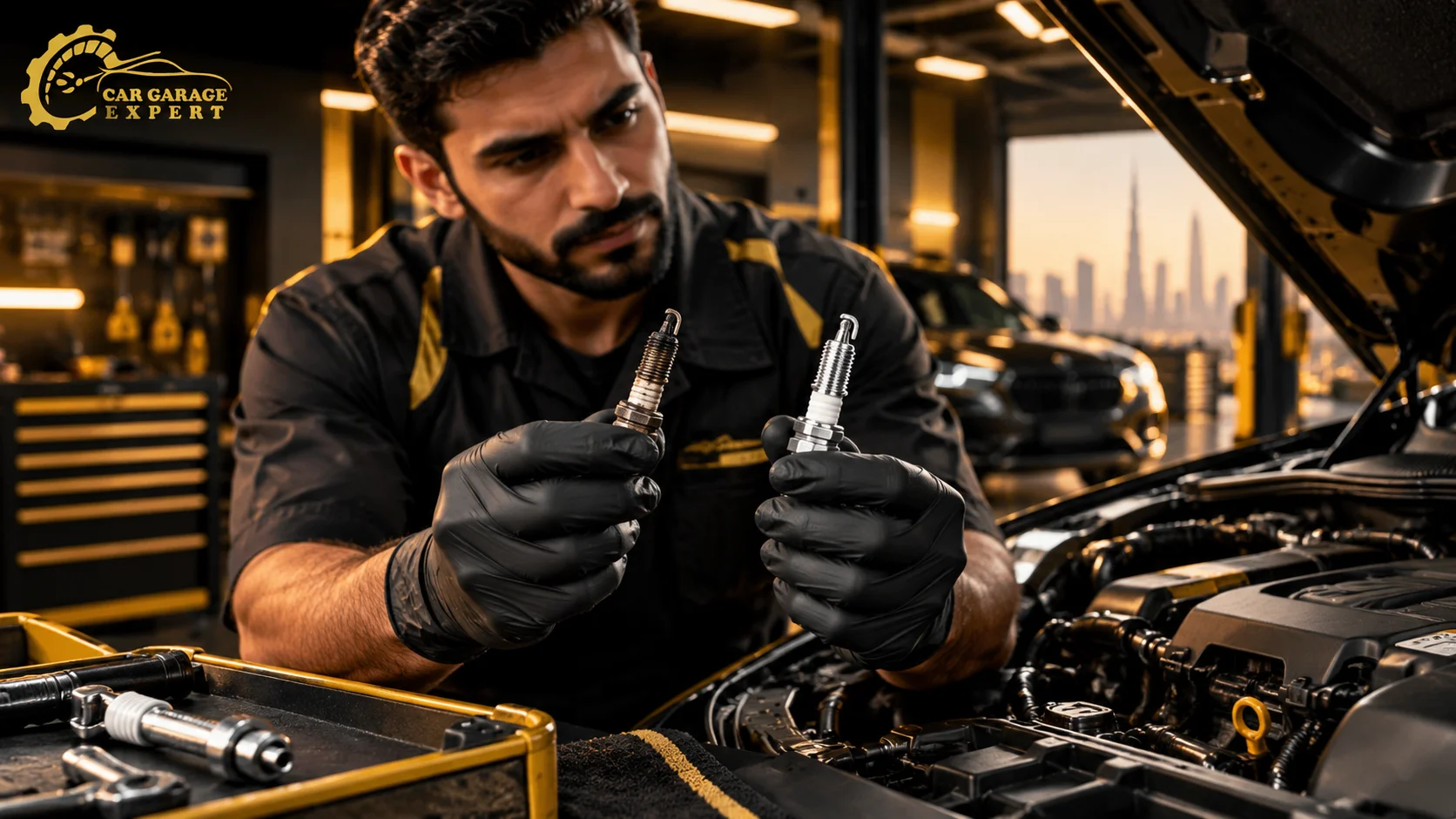
Our car painting process for Porsche models includes spectrophotometer measurement of the existing finish, test panel spraying before touching the car, correct flash-off times between coats, and UV-stable clear coat application suited to Dubai’s intense sun exposure. The final check is always done in natural light — not just booth lighting.
The Porsche Body Repair Process Done Correctly
A proper Porsche body repair sequence for a mid-severity job — a dented door with paint damage — looks like this:
Structural check first. Every collision repair starts on the ramp. Hidden damage behind panels, to sills, or to structural members gets identified before any cosmetic work begins. This is non-negotiable.
Panel removal where needed. Proper access to a damaged panel means removing it or adjacent panels where necessary. Trying to repair in-situ to save labour time produces inferior results.
Metal repair — minimal filler. High-strength steel panels get worked with appropriate body hammers and dollies to remove as much deformation as possible before any filler is applied. Aluminium panels follow a different procedure using aluminium-specific tools. Filler is applied only where metal work can’t fully restore the surface — in thin, even applications, never as a substitute for proper metal repair.
Primer, guide coat, and sanding. This is the step that reveals remaining low spots. A guide coat — a thin contrasting colour sprayed over the primer — shows exactly where the panel isn’t flat when sanded. Skipping this step in Porsche body repair is how technicians miss subtle low spots that show up as shadows in finished paint.
Colour coat and blending. Base coat applied to the repaired panel and blended into adjacent panels to prevent a visible repair edge. On Porsche’s multi-stage finishes, this requires blending the effect layer and the base coat separately before clear coat.
Clear coat and polish. UV-resistant clear coat applied at the correct film thickness, cured properly, then machine polished to match the gloss level of surrounding panels.
Every Porsche body repair job at Car Garage Expert follows this sequence completely. Steps don’t get skipped to save time.
Sensor Recalibration After Body Repairs
Modern Porsches — particularly the Cayenne, Macan, Panamera, and Taycan — are loaded with driver assistance technology that lives inside and behind body panels. Front radar for adaptive cruise control, cameras for lane assist, parking sensors in all four bumpers, and ultrasonic sensors for blind spot monitoring all need to be recalibrated after any Porsche body repair that involves their removal or the panels surrounding them.
Skipping recalibration after a Porsche body repair leaves ADAS systems operating with incorrect reference points. A front radar that’s slightly misaligned activates emergency braking incorrectly or fails to detect vehicles at the right range. This isn’t a minor inconvenience — it’s a safety issue.
Our car service team handles ADAS recalibration as a standard part of any repair involving sensor-bearing panels — it’s included in the job, not an afterthought.
Additional Support for Porsche Owners
Beyond body repair, Porsche owners across Al Quoz and surrounding Dubai areas can rely on Car Garage Expert for:
Our roadside assistance team handles Porsche recovery correctly — AWD models like the Cayenne and Macan require flat-bed recovery, not tow-bar recovery, to protect the drivetrain. If your car is undriveable after a collision or a mechanical fault, we get it recovered safely.
Our mobile car mechanic service covers initial assessments at your location — useful after minor collisions where you need to understand the damage scope before deciding on next steps.
For Porsche owners looking for a trusted Porsche body repair workshop without driving across the city, our garage near me location in Al Quoz is accessible from Jumeirah, Business Bay, Motor City, and Barsha without significant traffic exposure.
FAQ
Can dents on a Porsche be repaired without repainting?
Yes — paintless dent repair works on Porsche panels where the paint is intact and the dent hasn't stressed the clear coat.
How important is paint blending in Porsche body repair?
Critical — without blending into adjacent panels, colour and texture differences are visible in natural light on Porsche's multi-stage finishes.
Does Porsche body repair require sensor recalibration?
Yes — any repair involving bumpers or panels housing radar or camera systems requires ADAS recalibration before the car is safe to drive.
Can aluminium Porsche panels be repaired or do they need replacement?
Many aluminium panels can be repaired by a specialist — but it requires aluminium-specific tools and technique, not standard steel body repair methods.
Will an independent Porsche body repair shop affect my insurance claim?
No — independent workshops can handle insurance repair work; always confirm directly with your insurer before proceeding.
In Conclusion
Porsche body repair done correctly is invisible — the car should look exactly as it did before the damage, perform exactly as it was designed to, and hold up in Dubai’s sun and heat without fading or cracking paint within a year. That only happens when the structural inspection is thorough, the metal work is done properly, the paint is matched precisely, and the sensors are recalibrated after reassembly.
Book your appointment with Car Garage Expert and get your Porsche repaired by a Porsche body repair specialist who understands exactly what these cars need. We handle all Porsche models across Al Quoz and nearby Dubai areas — from minor paint correction to full collision repair. Find us on Google Maps and get the damage assessed properly before it goes anywhere else.