A dent, a scrape, or a collision repair might seem like a cosmetic concern — but in Dubai’s market, how well a car presents directly affects its resale value, its insurance assessment, and the owner’s daily relationship with what is often a significant financial asset.
Finding the right body repair shop in Dubai means finding one that matches paint correctly, restores panel geometry accurately, and doesn’t cut corners on preparation — because in bodywork, preparation is where quality repairs are made or broken.
Dubai’s specific environment adds pressure to every paint repair. The UV index here is among the highest globally. A repair that uses incorrect clear coat chemistry fades visibly against the surrounding original panels within months. A repaired panel that wasn’t properly primed starts showing adhesion failure faster than it would in a cooler, less UV-intense climate.
Body Repair Shop Dubai — Why Quality Preparation Separates Good Work from Poor
The visible difference between a good body repair and a poor one usually comes from what happened before any paint was applied.
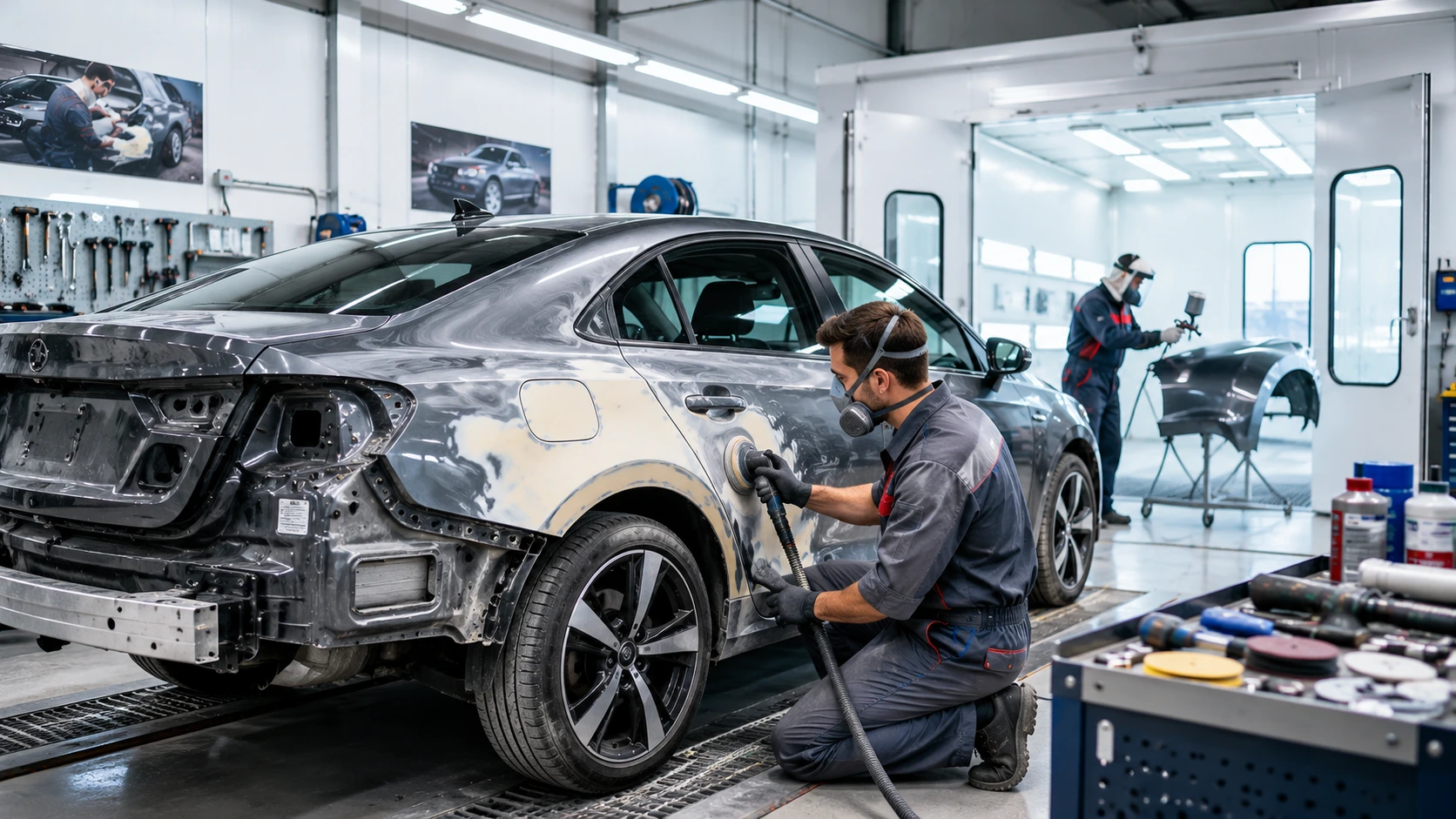
Surface preparation — cleaning, sanding, priming, and filling in the correct sequence with the correct products — determines how well the new finish bonds to the substrate, how smooth the final surface is, and how long the repair lasts under Dubai’s UV and heat.
A body repair shop that rushes preparation to reduce labour time produces a repair that looks acceptable for the first few months and then starts showing edges, colour variation, and surface irregularity as the shortcuts reveal themselves. The repair that seemed cheaper initially becomes more expensive when it needs redoing.
A Lexus ES came to Car Garage Expert after a budget bodyshop had repaired a rear quarter panel following a parking lot impact. Within four months, the paint on the repaired panel had developed visible fading at the edges where the new paint met the original — a preparation failure where the blend zone wasn’t properly feathered and the correct UV-resistant clear coat wasn’t used. The panel had to be redone entirely.
Services a Proper Body Repair Shop Provides
A quality body repair shop handles the full range of bodywork from minor cosmetic damage to structural collision repair.
Paintless Dent Removal
Paintless dent removal (PDR) is the correct technique for dents where the paint surface is undamaged — parking lot door dings, minor hail damage, and small impact dents where the metal has deformed without cracking the paint film.
PDR uses specialised tools to massage the metal back to its original profile from behind the panel, without any need for filling, priming, or repainting. The result is invisible — the panel returns to factory condition with the original paint intact.
When PDR Works and When It Doesn’t
PDR is appropriate when the paint surface is unbroken and the dent is accessible from behind the panel. It isn’t suitable for dents at panel edges where the metal has creased, for dents where the paint has cracked or chipped, or for damage near structural reinforcements that block access.
A proper body repair shop assessment distinguishes between damage appropriate for PDR and damage that requires conventional repair — recommending PDR where it’s correct and conventional methods where PDR would produce an inferior result.
Conventional Dent Repair and Panel Straightening
For dents where the paint is damaged, where the metal has creased, or where panel geometry has been significantly altered, conventional repair involves pulling or massaging the panel back to its original shape, applying filler to restore a smooth surface, and repainting.
The panel straightening stage matters as much as the painting. A panel that isn’t correctly profiled before filling produces a finished result with subtle shape anomalies that are visible in certain light — particularly in Dubai’s strong directional sunlight that shows surface imperfections clearly.
Body Filler Application
Filler is a necessary part of conventional dent repair — but the correct amount and application technique matter significantly. Excessive filler applied over poorly prepared metal develops cracking and adhesion failure over time. Filler applied in correct thin layers over properly prepared metal lasts as long as the surrounding original panel.
A quality body repair shop applies filler in controlled thin coats, allows correct cure time between applications, and sands to a precise profile before primer application.
Collision Repair
Collision damage repairs require structural assessment alongside cosmetic repair. A panel that looks like a cosmetic concern can involve underlying structural geometry that needs restoring before any surface repair is meaningful.
A proper body repair shop assesses structural impact before authorising surface repair — because repainting a panel that sits on misaligned structural metal produces a finish that looks correct but sits incorrectly on the car.
Chassis and Structural Assessment
Significant collision damage that affects the vehicle’s structural geometry — A-pillar deformation, chassis rail displacement, floor pan impact — requires straightening on a dedicated jig before any panel work proceeds.
A body repair shop equipped for proper collision repair has alignment measurement capability to confirm structural geometry is restored to within specification before surface repairs begin.
Insurance Claim Repairs
Collision repairs conducted through insurance claims require specific documentation — photographic evidence of damage before repair, parts receipts, and sometimes insurance assessor approval for repair scope. A quality workshop understands this process and documents the repair correctly.
Paint Matching and Colour Correction
Paint matching is where the skill difference between body repair shop providers is most visible — and most consequential for the owner.
Manufacturer Colour Code Matching
Every vehicle has a manufacturer colour code that defines the precise pigment formulation for its specific paint colour. Using this code as the starting point for any repair is the baseline requirement.
However, paint colour drifts slightly with age and exposure — the original paint on a car that has been in Dubai’s UV environment for three years has faded slightly from its factory specification. A repair mixed exactly to the original code will be slightly brighter than the surrounding aged panels.
Blend Zone Technique
Correct paint matching on an older vehicle involves mixing the paint to code and then adjusting the blend zone — the area where new paint transitions into original paint — to disguise the slight colour difference that’s unavoidable between new and aged paint.
A body repair shop with experienced paint technicians executes this blend correctly. A workshop that sprays to the panel edge without blending into adjacent panels produces a colour step that’s immediately visible.
Specialist and Metallic Finishes
Metallic and pearl paint finishes require specific application technique to match correctly. The metallic flake orientation during spraying determines how the colour looks at different viewing angles — spray speed, distance, and air pressure all affect the final appearance.
Specialist finishes — two-tone paint, matte finishes, factory wraps — require specific expertise and products. A body repair shop that handles specialist finishes correctly uses the right primer system, the correct base coat formulation, and the specific clear coat chemistry for each finish type.
Common Body Repair Scenarios in Dubai
Dubai’s specific driving environment creates recurring body damage patterns that a quality body repair shop sees regularly.
Parking Lot Damage
Dubai’s multi-storey car parks — tight ramps, narrow bays, high-volume use — produce the highest volume of body repair work. Door dings, scrapes from narrow bay exits, and bumper contact from parking misjudgements are the most common damage types.
Most parking lot damage is cosmetic rather than structural and is well-suited to PDR where paint is undamaged, or conventional repair and repaint where paint is affected.
Stone Chip Damage
Dubai’s highways and the fine gravel that accumulates on road surfaces from construction activity create stone chip damage on bonnets, front bumpers, and lower door sills. Stone chips left unrepaired develop into rust entry points on steel panels — particularly on vehicles without factory rust protection on these surfaces.
A body repair shop that addresses stone chips with correctly prepared micro-repair — cleaning the chip, applying the correct primer, and matching the colour — prevents the rust development that turns a cosmetic issue into a structural one.
Sand Abrasion
Shamal season deposits fine sand across every exterior surface. Cars that are washed improperly during high-dust periods — wiped with a dry cloth or washed without adequate water lubrication — develop swirl marks and fine scratches in the clear coat that reduce paint depth and lustre.
Sand abrasion doesn’t usually require panel repainting — it’s addressed through machine polishing that removes the damaged surface layer of clear coat and restores gloss. A proper body repair shop assesses whether polishing is sufficient or whether the clear coat damage has penetrated too deep to correct without repainting.
Accident Damage
Road accidents — even minor ones — can involve panel deformation beyond cosmetic damage. A rear impact that creases the boot lid and pushes the rear quarter panel forward has moved the structural geometry slightly, affecting how the boot lid opens and closes and how the rear door gap aligns.
Visible gap changes after any impact are an indicator that structural alignment needs assessment before surface repair. A proper body repair shop checks geometry before panel work rather than painting over misaligned panels.
The Importance of Warranty on Body Repairs
A quality body repair shop stands behind its work with a repair warranty. Paint adhesion failure, colour mismatch becoming visible within months, or filler cracking appearing under the surface — these are preparation failures that a shop confident in its work covers under warranty.
Asking about the repair warranty before authorising work is a reasonable quality indicator. A workshop that doesn’t offer any warranty on paint repairs has no financial incentive to execute preparation correctly.
Combining Body Repair with Mechanical Service
Bringing a car in for body repair alongside mechanical maintenance is practical — one workshop visit rather than separate appointments at separate locations.
A full car service covers the mechanical side while body repairs are underway. Both complete at the same time and the car leaves in correct mechanical and cosmetic condition together.
For structural collision repairs identified during the body assessment, a qualified car mechanic handles any mechanical damage alongside the structural work — suspension components affected by the impact, cooling system damage from a front collision, or electrical system damage from water or impact intrusion.
A mobile car mechanic can conduct an initial assessment at the damage location — confirming whether the car is safe to drive to the workshop or requires recovery before any movement. Proper roadside assistance ensures collision-damaged vehicles are transported correctly — preventing additional suspension or underbody damage during recovery from a collision that may have already compromised these components.
For owners in Al Quoz and surrounding areas looking for a garage near me that handles body repair alongside full mechanical service — combining both under one roof saves time and ensures the mechanical assessment that often accompanies collision repairs isn’t skipped.
FAQ
What is the difference between PDR and conventional dent repair?
PDR is used when paint is undamaged — tools reshape the metal from behind without repainting. Conventional repair is required when paint is cracked, the metal has creased, or the dent is inaccessible from behind.
How long does a body repair shop take to fix collision damage?
Minor dents and scrapes typically take one to two days. Structural collision repairs requiring alignment, panel replacement, and full paint matching can take three to seven days depending on parts availability.
Will the paint colour match exactly after a body repair?
On newer vehicles it's very close to exact. On older vehicles with UV-aged paint, correct blend zone technique minimises visible colour difference — a quality body repair shop executes this blend rather than painting to panel edges.
Does body repair affect the car's resale value?
A quality repair using correct preparation and proper paint matching has minimal impact on resale value. A poor repair that's visible under inspection — mismatched colour, visible filler cracking, overspray on rubber trim — reduces value significantly.
How do I know if a body repair shop is using genuine manufacturer paint codes?
Ask to see the paint mixing slip or the paint code used before work begins. A quality shop provides this without hesitation.
Conclusion
A proper body repair shop in Dubai produces work that’s invisible — repaired panels that match the surrounding original paint in colour, texture, and clarity, and structural repairs that restore geometry correctly rather than disguising misalignment with surface finish.
Car Garage Expert in Al Quoz handles the full range of body repair work — PDR, conventional dent repair, collision damage, paint matching, and specialist finishes — with preparation standards and colour matching that last in Dubai’s UV environment. Book your appointment on WhatsApp or find the workshop on Google Maps.